I’ve been digging into Gray’s time in Paris because it was a significant chapter in his life as an artist. The residency at the Cité Internationale des Arts placed him in the middle of a lively international scene and galleries full of the works he had only read about. As I talk to people who were there, I’m struck by how differently they remember the same events and how these varied recollections help me build the most honest picture I can. This is still a work in progress and I welcome comments from anyone who holds a different version of these moments.
In 1967–68, Gray, his wife Joan, and their five children set sail on the Fairsea for the six week journey to Southampton before heading to France. Gray and Joan shipped many paintings with them that Gray would exhibit in Paris.
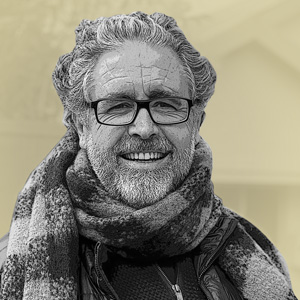
This post is mainly based on an interview I did with Arthur Wicks a few weeks ago. Now in his 90s, still sharp and with a wicked sense of humour, Arthur is an experimental Australian artist who moves between painting, printmaking, performance, machines and larger conceptual projects. He recently had an exhibition of his paintings from 1967 to 1974 at the Wagga Wagga Art Gallery.
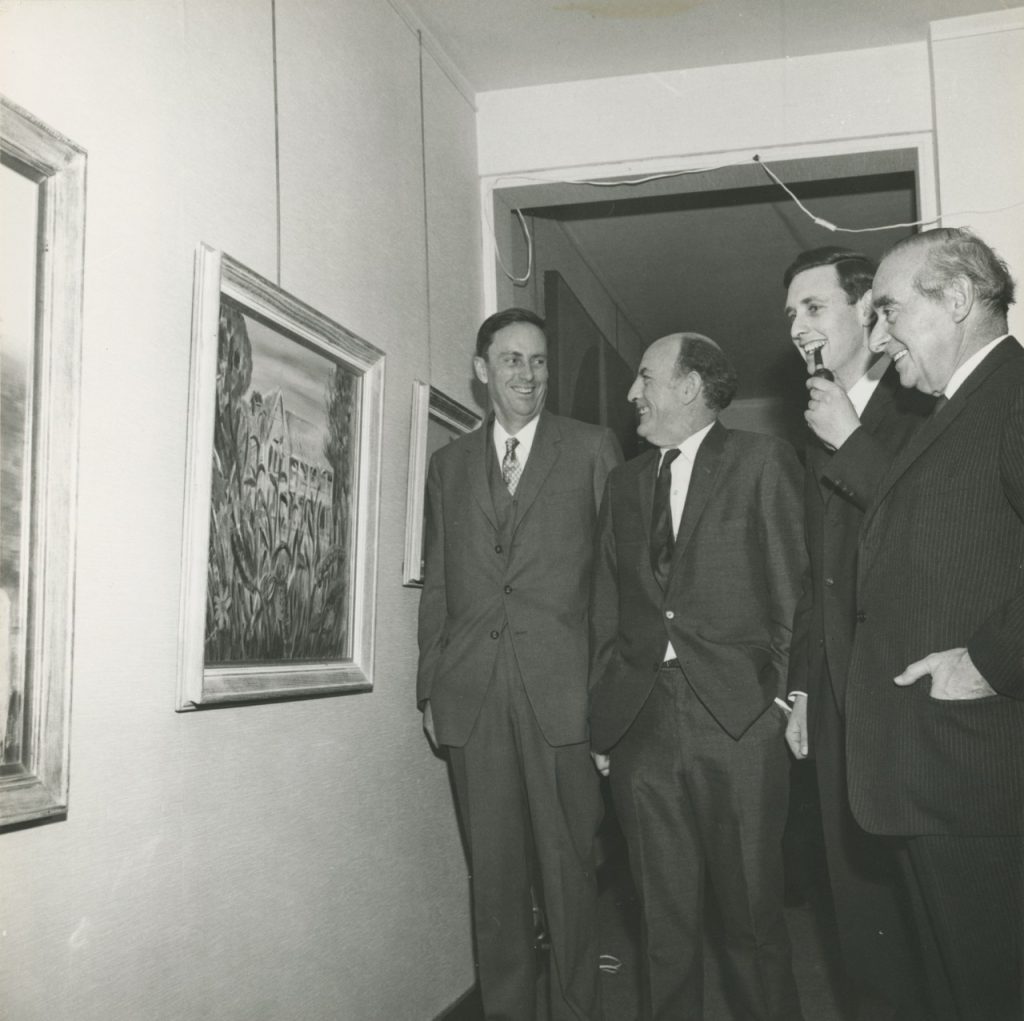
The adventure in Paris started with a mix up. Arthur remembered that the studio Gray expected to use had also been promised to him. Both artists had been selected for residencies at the Cité, and their joint exhibition, Deux Aspects de la Peinture Australienne: Gray Smith, Arthur Wicks, was organised as part of that arrangement. The photo shows Gray second from the right and Arthur smoking a pipe. The painting they are looking at is called The Rectory, brought over on the ship from Canberra. The residency became the start of a strong friendship that lasted well beyond their time in Paris.
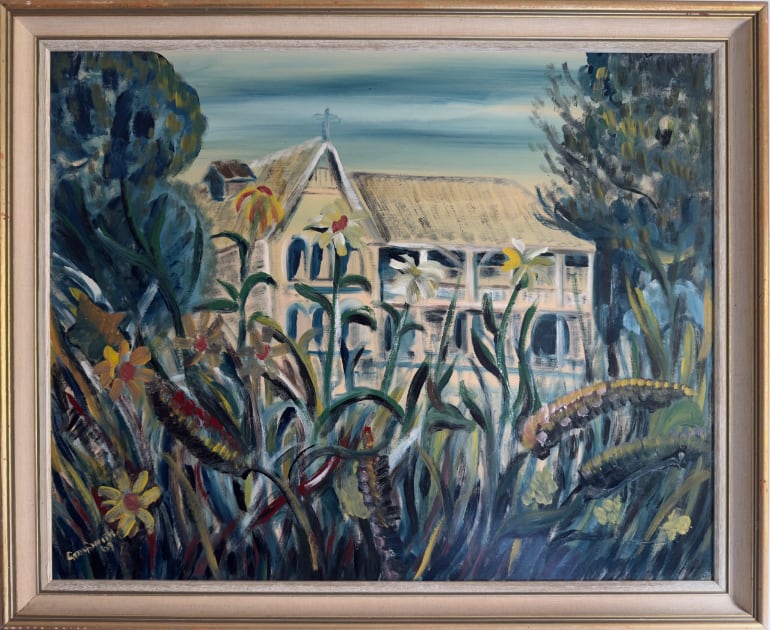
© Smith Estate. Used with permission via CAL.
Henri Souillac, the French cultural attaché in Canberra, had arranged Gray’s residency. In Arthur’s telling, Souillac had assured Gray that a studio would be waiting for him at the Cité. But when Gray arrived he found the space already assigned to Arthur through Bernard Smith, the influential art historian at the University of Sydney’s Power Institute. Arthur remembered Gray landing in Paris only to realise he had nowhere to stay.
Arthur had already solved his own problem. He and his wife Joan had two young children, Bronwyn and Suzie, so the cramped studio was never going to work. He remembered they rented a house at Ormesson on the Marne, “because I had two young children, there was no way you could live in the cramped studio… so we rented a house at Ormesson, out in the suburbs on the Marne River.”
When Gray and Joan arrived with Perry, Fern, Brett, Matthew and Sheenagh, the promised studio was gone and there were no other options. Arthur remembered Gray turning up “with all his paintings” only to find the place unavailable. The two families ended up sharing the house at Ormesson. Arthur was living on a French government scholarship and the Dyson bequest, and he later summed up the whole scene as “a tale of woe”.
As the two men settled into life in Paris, the friendship took on its own rhythm. Arthur told me about taking Gray and Joan to a Robert Morris opening at Galerie Ileana Sonnabend. Morris had nine fibreglass columns on display, “and that was it”, he said. Arthur was mid-conversation with Morris, trying to squeeze insights out of him, when Gray wandered over and asked, “oh, you’re responsible for this?” then added, “oh God, that’s garbage.” Morris looked at them both and walked away without a word. Arthur laughed as he remembered it. “Thanks, Gray.”
Their friendship grew quickly and they looked after each other. After a Qantas event some time after their joint exhibition, Arthur had drunk far too much whisky. Gray was driving. As they circled the Arc de Triomphe, Arthur felt himself slipping and said, “oh look, I’m gonna chunder… you gotta stop.” Gray kept the car moving. “Oh, I can’t, I’m in the middle of the aperture,” he said. Arthur still chuckles. “That’s classic.” Arthur remembers Gray being very forgiving of the situation.
As I talk to people about this period, I keep seeing how memory bends and shifts. Some details line up neatly, while others drift depending on who is recalling the moment. It’s a reminder that recollection is rebuilt each time we reach for it. For my research it means listening for patterns, comparing versions, and accepting that the most faithful picture is often found across these varying accounts rather than inside any single one.