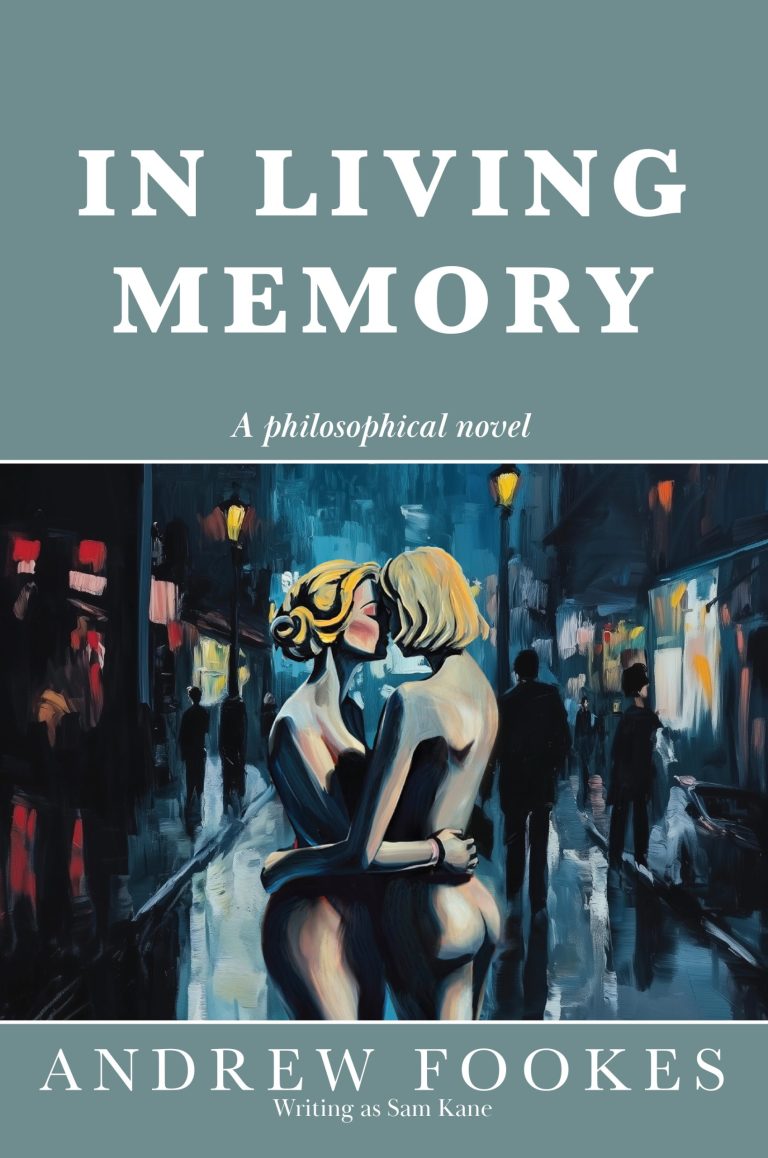
I’m a friend of Andrew Fookes, and I went to the launch of his book, In Living Memory. It’s a work of fiction, so I wasn’t reading it for biographical accuracy. What interested me was something else entirely: what Andrew chose for his characters to say about artists, who they named, who they grouped together. And who was spoken about as if their place was already understood.
I’d heard that Gray was mentioned in the book and was pointed to the page numbers, so I turned there first. What struck me wasn’t the detail of the scenes, but the ease with which Gray’s name appeared in the conversation.
Fookes writes:
“They were friends of John and Sunday Reed of the Heide Circle, but their connection to the Angry Penguins was more social than artistic.
“The Angry Penguins?” Cate asked. “Is that a theatre group or something?”
Renee smiled. “No, a rather volatile and eccentric group of Modernist artists involved with the Heide Circle. Albert Tucker, Joy Hester, Sidney Nolan, Gray Smith, Arthur Boyd and a couple of others. An interesting chapter in Australian art history. If you like, I can recommend a few titles for you to read, though it seems you guys already have plenty on your plate.” (p. 285)
That single sentence does a lot of work.
Albert Tucker. Joy Hester. Sidney Nolan. Arthur Boyd. And there it is. Gray Smith. No qualifier. No explanation. No sense that the name needs justifying.
This is how reputations live or fade. Not through grand reassessments, but through ordinary conversation. Through lists like this. Through who gets named when someone says, “You know, that group.”
What makes this even more interesting is that Gray appears earlier in the book as well. Fookes mentions him in relation to Joy Hester leaving Melbourne with Gray in 1947. It’s a well-worn part of Heide lore.
But again, the detail matters. The footnote reads: “Gray Smith, Australian artist and poet (1919–1990).”
He’s not reduced to being simply the man Joy ran off with. He’s named, dated, and identified as an artist in his own right.
In Living Memory is a big book, over 900 pages. I haven’t read every page yet, though I plan to. But you don’t need to read the whole book to notice when memory is doing its work. You see it in moments like this. In which names surface naturally. And who they are placed beside.
This is how an artist re-enters the conversation. Not with a trumpet blast. Just by being said out loud, alongside the others, as if they were always meant to be there.
There’s a body of research that helps explain why this matters so much. Psychologist James Cutting explored this in detail in a 2003 paper titled Gustave Caillebotte, French Impressionism, and Mere Exposure, which laid the groundwork for his later book on artistic canons.
Cutting is very explicit about what he means by a canon and how it behaves:
“An artistic canon consists of a culture’s esteemed works of painting, sculpture, architecture, music, theater, poetry, literature, or film. The membership of works within a canon is graded—some are central, some less central but firmly within, some on the margins, and some clearly outside.” (p. 321)
Crucially, he argues that exclusion from the canon is not primarily about lack of quality:
“I assume that artworks within a canon deserve their position but also that many works on the fringes and even well outside are equally worthy and equally deserving of cultural reverence.” (p. 321)
So what keeps some works visible and others marginal? Cutting’s answer is blunt. It’s repetition.
“The repeated presentation of images to an audience without its necessarily focused awareness or remembrance makes mere exposure a prime vehicle for canon maintenance.” (p. 335)
Over time, this repetition changes preference:
“Tacitly and incrementally over time, this broadcast teaches the public to like the images, to prefer them, eventually to recognize them as part of the canon, and to want to see them again.” (p. 335)
Importantly, Cutting found that preference had little to do with judgments of complexity or recognisable ‘quality’:
“Across the studies, adult preferences were correlated with differences in image frequencies, but not with recognition, complexity, or prototypicality judgments.” (p. 319)
This is the uncomfortable implication. Canons are stabilised not because art history keeps discovering the ‘best’ work, but because the same works and names keep circulating. Museums, books, lectures, catalogues, conversations. Each repetition makes the next repetition more likely.
Seen through this lens, moments like Fookes naming Gray alongside Tucker, Hester, Nolan, and Boyd aren’t small at all. They are acts of exposure. They increase familiarity. They make future mention more likely.
That’s how memory becomes history. Not by decree, but by repetition.
References
Cutting, James E. “Gustave Caillebotte, French Impressionism, and Mere Exposure.” Psychonomic Bulletin & Review 11 (2003): 319–43.
Cutting, James. Impressionism and Its Canon. Lanham, MD: University Press of America, 2006.
Fookes, Andrew. In Living Memory: A Philosophical Novel. Melbourne: Phenomenology Press, 2025.

2 Responses
Thanks for that fascinating insight, Shawn. I see I’m guilty of the phenomenon James Cutting mentioned in your excerpt. By using the words ‘and a couple of others’ rather than the names Danila Vassilieff and John Perceval, I unintentionally took two Angry Penguins right out of focus.
When I think back to why I made that choice, I see elision rather than dismissal. I shortened the sentence for brevity and clarity, not as a comment on the artistic merits of Perceval and Vassilieff. And this also demonstrates your point about the ruthless randomness of exposure.
And of course, memory is a disruptor of lists too. Whichever mechanism we use to remember something may well reshape our recollection of it. There’s no chain of custody protecting the survival of fragments of memory – names, places, dates, all fall through the cracks of our attention as it extends through time. How different might our knowledge of our history be otherwise?
Congratulations too on this Gray Smith project – it’s important work to restore discarded narratives before they wither.
Thanks, Andrew. That’s a generous and careful reading.
I really like your distinction between elision and dismissal. It gets at the heart of what I was trying to tease out. Most of this isn’t malice or judgement. It’s economy. We shorten, we compress, we tidy. And in doing that, whole people can slip out of view without anyone intending it.
Your point about memory really resonates too. There’s no protected pathway that keeps names intact over time. What sticks is often what was repeated, or personally anchored, or just lucky enough to be mentioned again. Everything else slowly thins out.
I’ve seen this play out again and again while working on Gray. A small early mention. Then silence. Then suddenly it’s as if he was never there at all. Not erased. Just not carried forward.
Really appreciate you engaging so thoughtfully, and for the encouragement. Conversations like this are exactly why I’m putting the work out in public.