It was New Year’s Day 2022. We were sitting on the balcony in Portarlington, looking out over Port Phillip Bay on a sunny afternoon. All but one of Gray’s children were there with their partners. I’m a partner of Sheenagh, Gray’s youngest.
I’d floated the idea of a Wikipedia page about Gray a few times with the family, but each time I met some resistance. Not hostility, just a kind of passive dismissal. I suspect they didn’t want the angst of stirring up old stories. But that day, maybe it was the white wine in the sun, or maybe just the warm weather and the good feeling of being together, the mood shifted. I raised the idea again, and this time everyone nodded. There might even have been a raising of glasses and a quick cheers.
As soon as I got back home, I started writing. Three days later, I’d finished at least the initial version of Gray Smith’s Wikipedia page. And here it is.
Fast forward to 2024. Sheenagh and I visited Heide Museum of Modern Art and were excited to see a new exhibition, Always Modern: The Heide Story. Walking through the cottage, I counted eight Nolans, five Hesters, four Blackmans, three Tuckers, and three Boyds, among others. But not a single Gray Smith. We were annoyed. That’s probably an understatement. Despite the gallery owning 22 of his works, not one made it into the show.
You might think Gray’s paintings just weren’t up to standard. But as you’ll see in this biography I’m writing, that’s far from the truth. For example, when John Reed (who started Heide with his wife Sunday) opened his Museum of Modern Art Australia in 1958, he sent a Gray Smith painting (The Tank) to MoMA in New York to mark the event. He could have chosen a Nolan, a Boyd, or a Tucker, but he chose a Gray Smith.
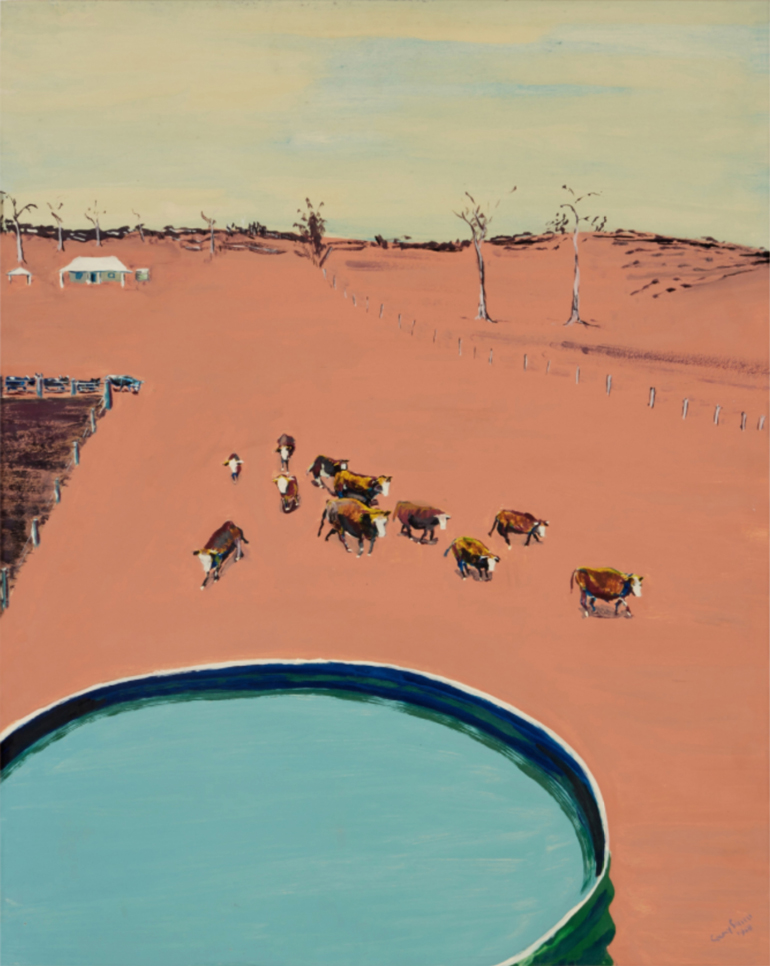
© Smith Estate. Used with permission via CAL.
So I launched an email-writing campaign, emailing all the Heide directors and curators. I didn’t actually know all their addresses, so I made some up, figuring that whoever received my messages would assume the whole group had got them as well. The next day, I got a call from Kendrah Morgan, the curator of the exhibition. We arranged for her to come to our place to see more of Gray’s paintings and chat about her exhibition.
When Kendrah visited, she loved what she saw. She asked to borrow a work Gray had painted of the Heide cottage around 1945. I got the sense she genuinely wanted to include Gray in the exhibition, but felt the Heide collection didn’t show him at his best. She told us she only wanted to present his strongest work so it would be viewed favourably among all of the others.
Writing the Wikipedia page sent me digging into the many books that mention Gray, and I could see an injustice at play. He was side-lined, put down, even sneeringly dismissed as just a picture framer. So I pulled together a talk about how fickle the art world can be, who gets included and who gets left out, using Gray as the example. I showed lots of his paintings and gave the talk to about 50 people at Heide Museum of Modern Art.
Kendrah has been a tremendous support for my project. She has generously shared her time, expertise, and advice to help me get started. As the author of books that place Gray within the context of John and Sunday Reed, and of course his wife Joy Hester, she is a true expert on the Heide Circle. I’m grateful for her assistance, and she and her colleagues have provided me with excellent access to the Heide archives.
It was clear no one else was going to write Gray’s biography, and I’d become fascinated by all the twists and turns in his life. So I booked more time in the archives and started reading everything I could about him. I’m now well into the writing, and this website is part of that journey. If you have stories, memories, artworks or writings connected to Gray, please get in touch. I’d love to see and hear what you’ve got.