Follow:

Gray Smith and the Tales and Legends of Canberra Pioneers

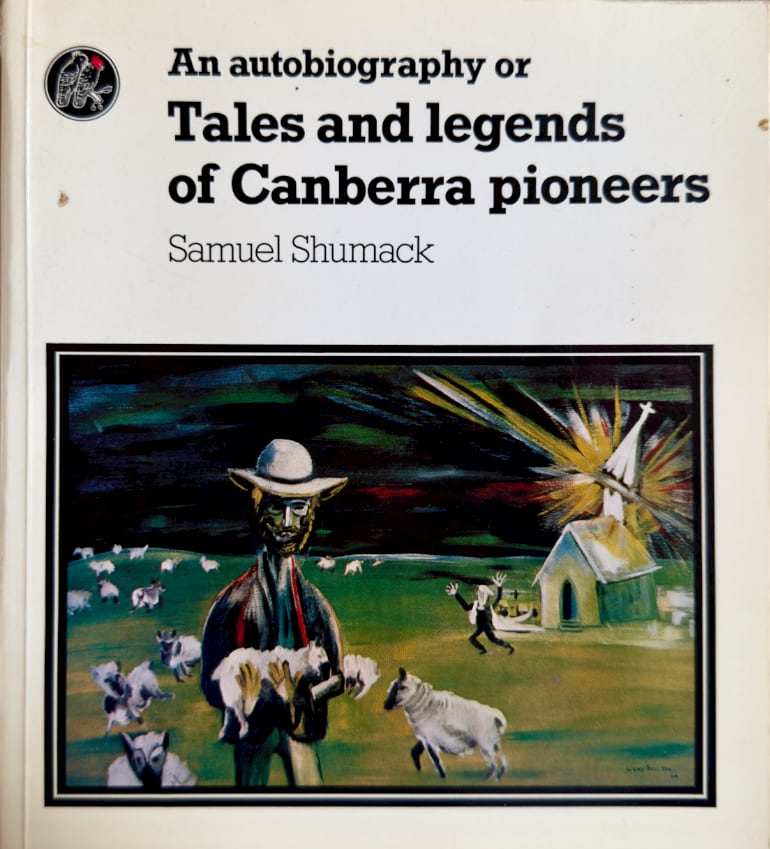
When Tales and Legends of Canberra Pioneers was published in 1967, the Shumack family turned to Gray Smith to bring Samuel Shumack’s words to life. Eight of Gray’s Canberry paintings were chosen to illustrate the book, capturing not just the pioneer stories but the spirit of the region itself.
IMG
My personal and somewhat beat-up copy.

Samuel Shumack arrived in the Canberra region as a boy in 1856, farmed for most of his life, and only began writing after an accident in his 50s forced him to retire. What started as an autobiography grew into a collection of anecdotes, myths, and pioneer stories that painted a vivid picture of early Canberra. My family, the Southwells, is often included in his tales. His manuscript sat in family archives for decades before his sons finally brought it to print, with Gray’s paintings giving colour and form to their father’s words.

I thought I would share two of my favourite paintings from the book: St John’s Struck by Lightning and The Flooding of ‘The Harp of Erin’.

I’ve been to one funeral and multiple weddings at St John’s Church, including one where I was a groomsman. So I thought I knew the church well. But it has gone through a few versions since its first incarnation in 1844.

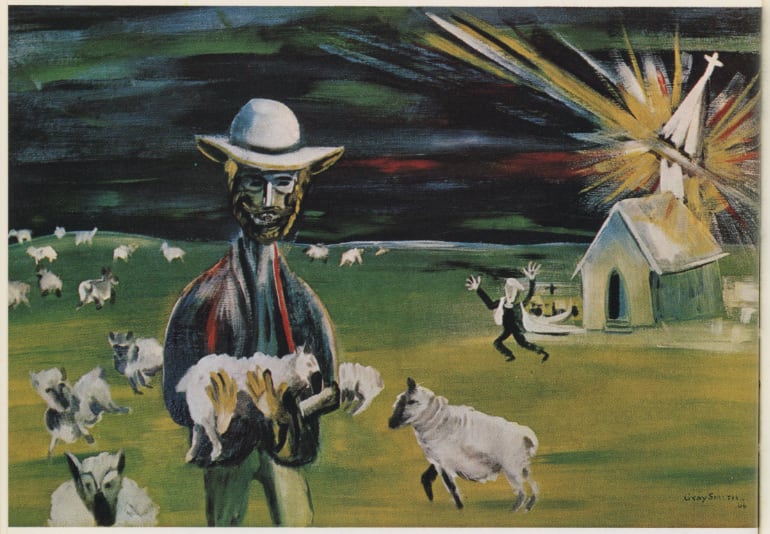
Gray’s painting depicts one of those early versions of the church in a dramatic moment with the spire exploding, the Reverend running for his life, while a farmer calmly gathers a lamb. While the caption says “The tower of St John’s Church, Canberra, struck by lightning in 1851,” there’s no mention of this event in Shumack’s recollections, nor anywhere else I could find. There’s a reference to the spire subsiding and needing to be rebuilt, but I couldn’t find anything about the spire being destroyed by a lightning bolt — possibly a creative figment of Gray’s imagination.

1966 St. John's Struck by Lightning
Gray Smith, St. John's Struck by Lightning, 1966. Enamel on board. Private collection. Courtesy of the Smith Estate. © Smith Estate. Used with permission via CAL.

It is certainly a narrative painting, like most of Gray’s Canberry series. To me, a narrative painting prompts the viewer to ask, ‘What happened?’ and ‘What might happen next?’ This simple storytelling approach increases audience engagement. I remember visiting the Van Gogh Museum in Amsterdam. I noticed some paintings had red dots, indicating they were the must-see works if you’re short on time. Most of them were narrative pieces: crows flying from a wheat field; a woman outside her home with smoke rising from the chimney; sowing the field; people eating potatoes. 

BTW, I’m trying to find Gray’s painting, St John’s Struck by Lightning. Let me know if you have any leads.

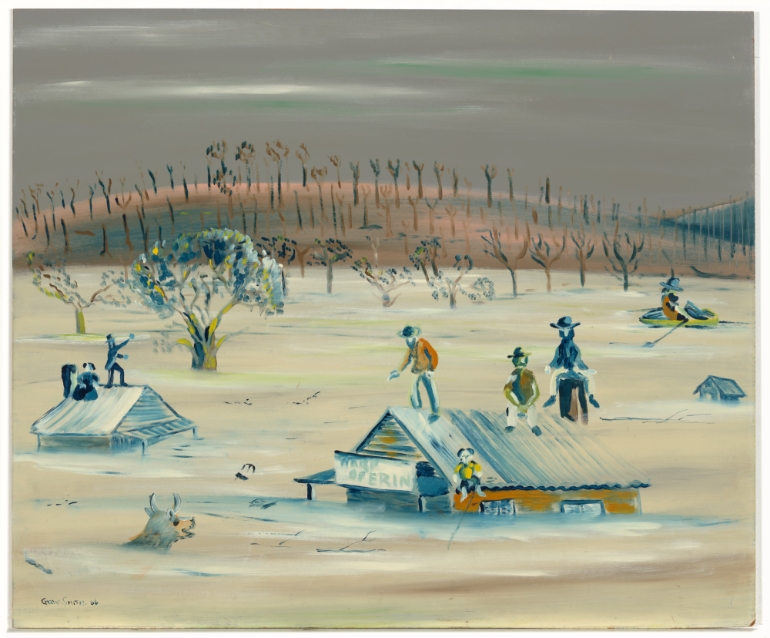
You can find The Harp of Erin Inn in Flood (1966) at the National Gallery of Australia. The pub was in Queanbeyan, on the floodplain of the Queanbeyan River.

The Harp of Erin Inn Flood
Gray Smith, The Harp of Erin Inn Flood, 1966. Enamel on board, 55 × 110 cm. National Gallery of Australia, Canberra. View work on NGA website. Courtesy of the Smith Estate.
© Smith Estate. Used with permission via CAL.

In this painting, Gray shows his affection for ordinary folk caught in extraordinary circumstances. It’s a flood scene, yet it’s not tragic. There’s humour and resilience in the figures, people perched on rooftops, chatting, rowing, helping each other. The composition feels light and human despite the bleak landscape.

It reflects Gray’s eye for community and survival, his empathy for people coping with nature’s indifference.

Gray’s wife, Joan Smith, was the researcher for these paintings. The Canberra Times in 1966 remarked that Joan was “The perfect wife for an artist,” noting “Mrs Smith has spent the past year doing the behind-the-scenes historical research necessary to uncover the subject matter which has provided her husband with inspiration for his 34 paintings.”

Funny how these old stories still ripple through our families. When I showed my mum Shumack’s book, she remembered having a Shumack as a teacher at Canberra High in the 1950s.

References

“Perfect Wife for an Artist.” The Canberra Times, October 13, 1966, p. 20.

Shumack, Samuel. An Autobiography or Tales and Legends of Canberra Pioneers. Edited by Shumack, Samuel, and J. E. Shumack. Australian National University Press, 1967.

You can still buy secondhand copies of Autobiography or Tales and Legends of Canberra Pioneers online.
Related posts

Picture of Shawn Callahan
Shawn Callahan

Hi, I’m Shawn Callahan, Gray Smith’s son-in-law. A few years ago, I wrote his Wikipedia page, which sparked a deeper dive into his life and work. Since then, I’ve been gathering stories, digging into archives, and speaking with Gray’s family—who’ve been incredibly supportive—to tell his full story. I’m also the author of Putting Stories to Work, an award-winning and best-selling book on business storytelling. Please join me in uncovering the full story of Gray Smith’s life.”

All Posts

Leave a Reply

Your email address will not be published. Required fields are marked *