In the early 1970s, the ABC’s Religious Broadcasting Department commissioned work from Gray Smith for a four-part television series on Daisy Bates.
The TV series, titled Daisy Bates—Our First Saint?, was developed by Professor James Tulip and broadcast nationally on ABC in March 1973. Gray’s paintings and illustrations were used across all four episodes.
This matters. It places Gray’s work inside a sustained national broadcast, not a one-off appearance. His images weren’t decoration. They carried visual weight across the full arc of the series, much like his painting that illustrated Samuel Shumack’s history of Canberra.
Who was Daisy Bates?
Daisy Bates was an Irish-born woman who arrived in Australia in the late nineteenth century and became known for her long association with Aboriginal communities, particularly in Western Australia.
For decades she lived at the edges of settler society, recording language, customs, and stories at a time when many believed Aboriginal culture was disappearing. She was widely read, frequently photographed, and often presented as an authority.
Her legacy is complicated. While she documented valuable material, her views were shaped by the attitudes of her time. Later scholars have questioned her methods, her assumptions, and the power she held over the people she wrote about.
By the early 1970s, Bates had become a contested figure. Not simply a historical curiosity, but a symbol of how Aboriginal people had been observed, interpreted, and spoken for. That reassessment forms the backdrop to the ABC series.
A 1972 Bulletin article by Don Anderson, titled Daisy Bates, Superstar, captures that moment well. Bates was once again a public figure, her reputation revived and challenged at the same time. Television played a central role in that renewed attention.
© Smith Estate. Used with permission via CAL.
Making art for television
Gray adjusted his practice to suit broadcast needs. Many of the images were produced on black paper because they reproduced better on black-and-white television. Contrast mattered. Subtle tonal shifts didn’t survive the camera.
This detail came from Diana Blom, who wrote the music for the series. She said the production team specifically asked Gray to work this way. He wasn’t just painting. He was solving a practical problem.
The paintings I’ve seen are restrained and economical. They don’t compete with narration. They support it. They’re designed to be read quickly, clearly, and at a distance. There is a beautiful image of Daisy floating in the air. When I find a good reproduction of the images, I will share them.
The ABC has since confirmed they can provide copies of the documentary for research purposes. Seeing the images in sequence, alongside the narration and music, will add another layer to how this commission is understood.
The Bible cartoons
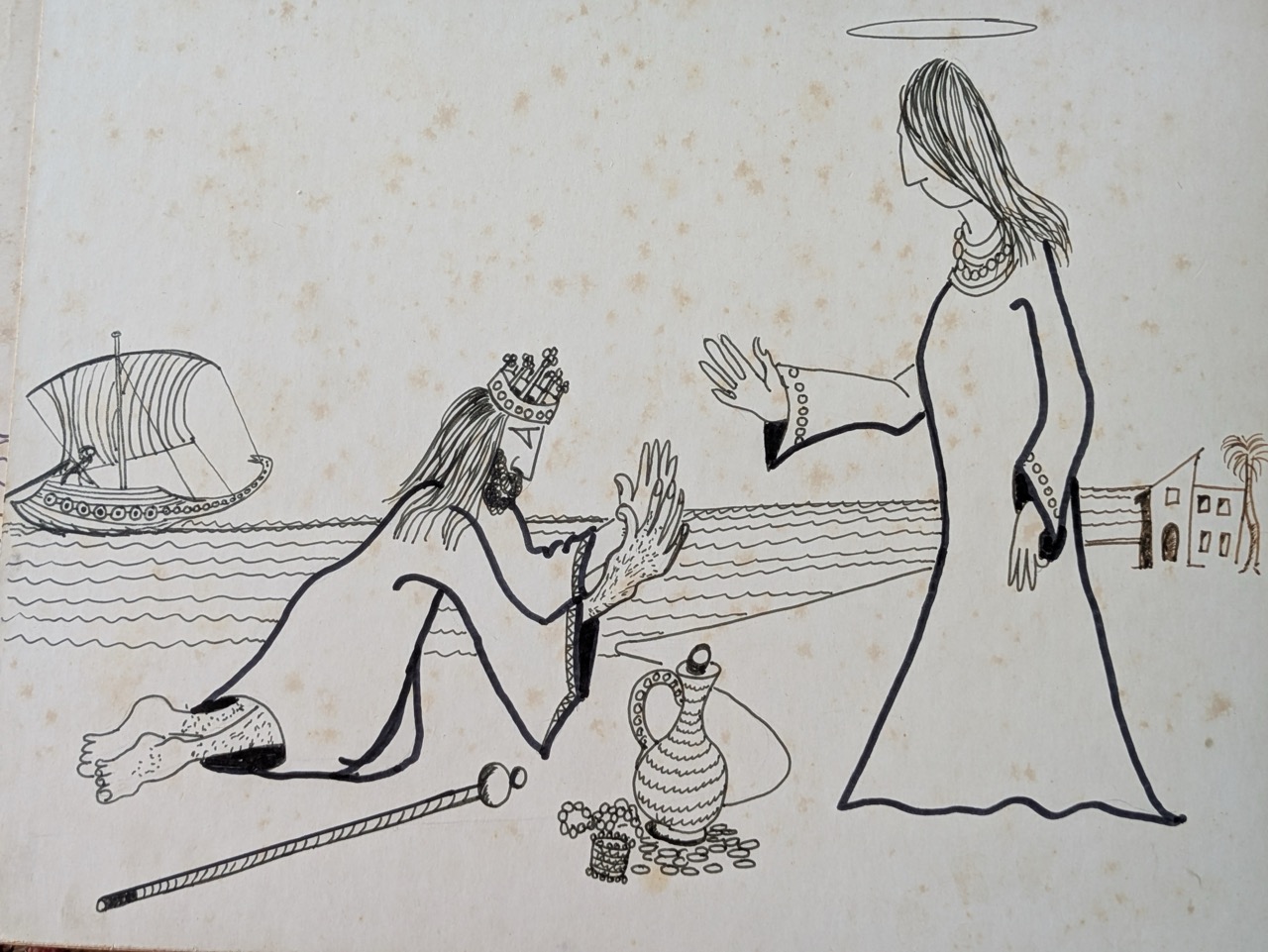
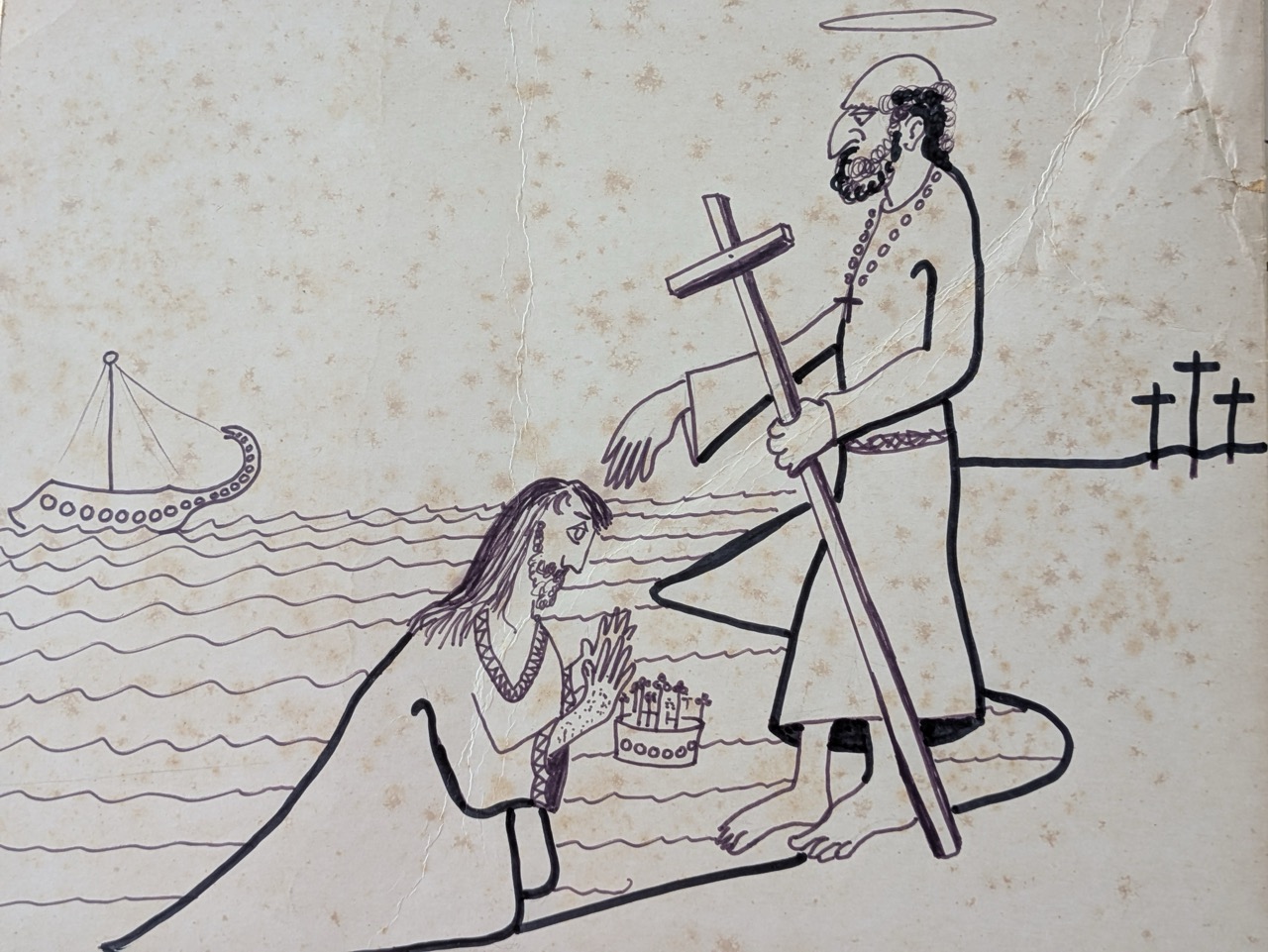
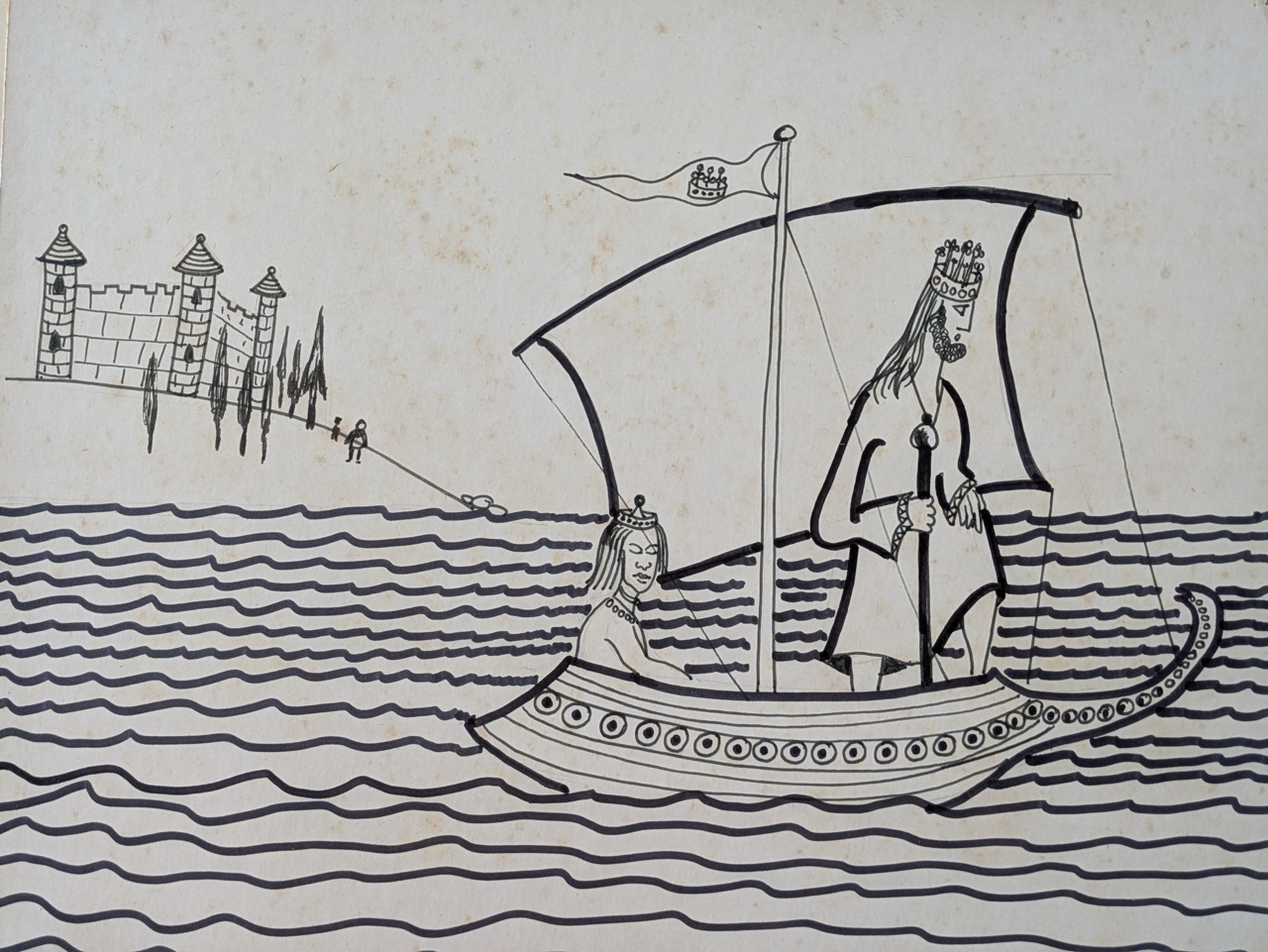
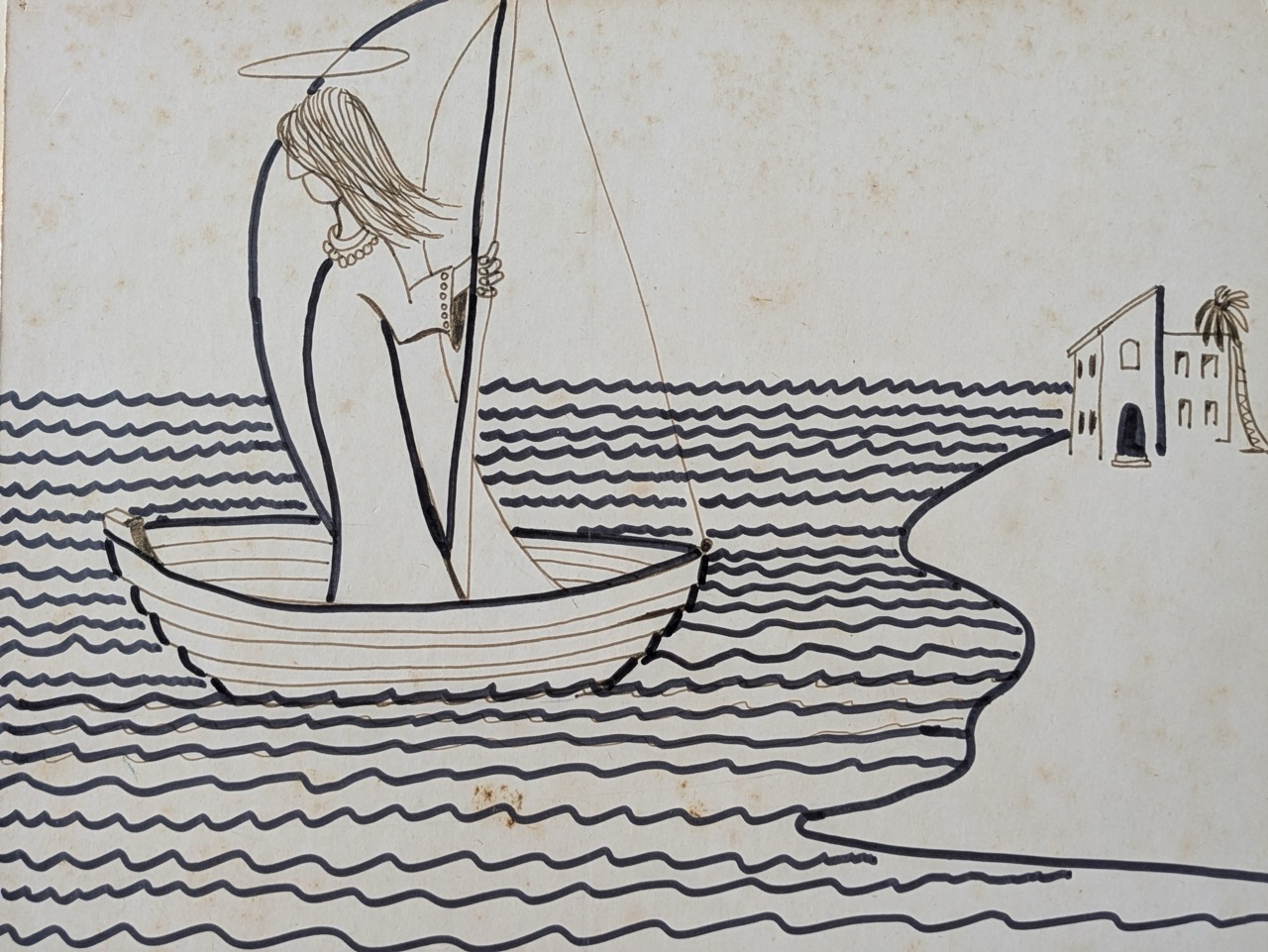
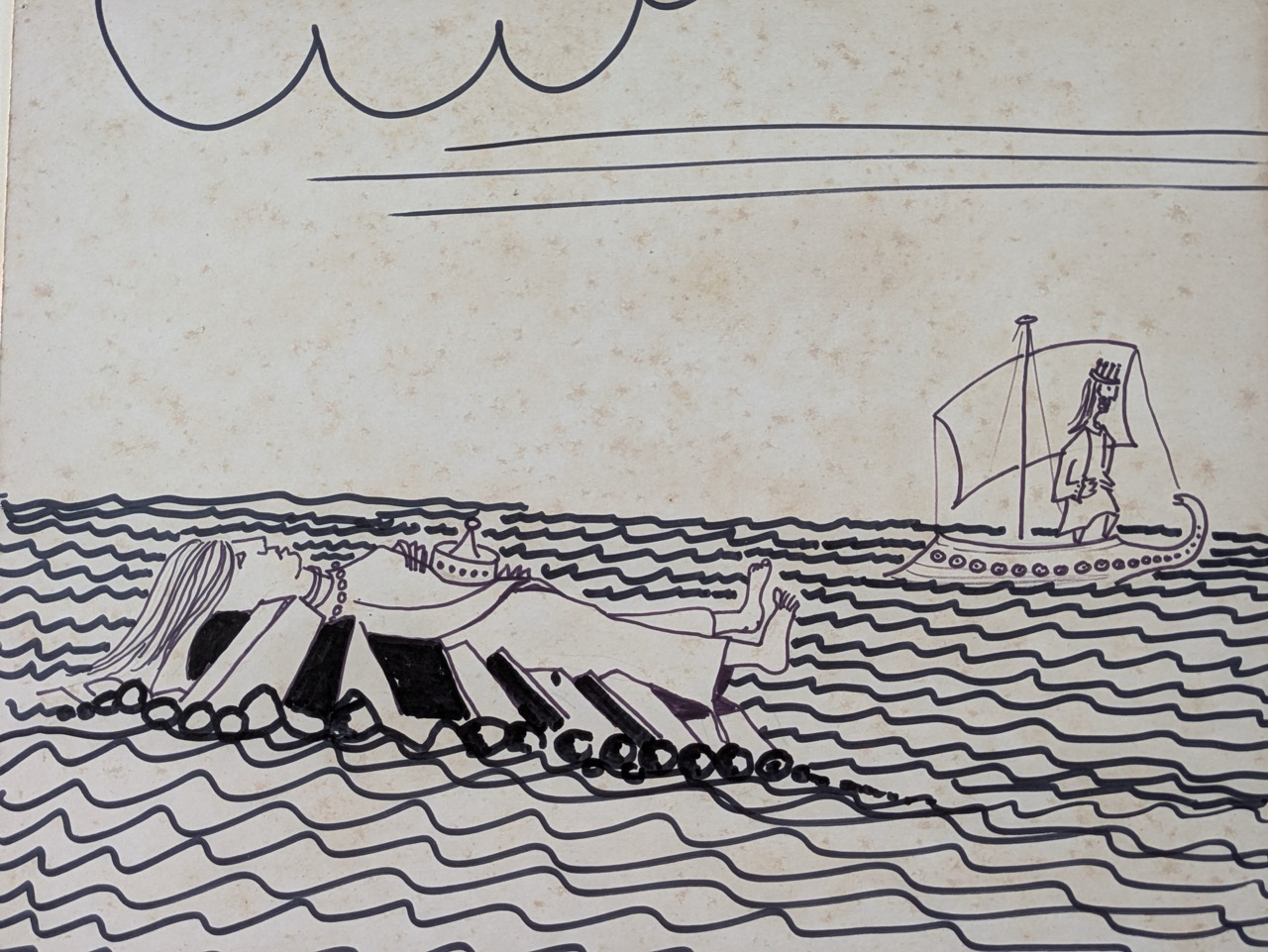
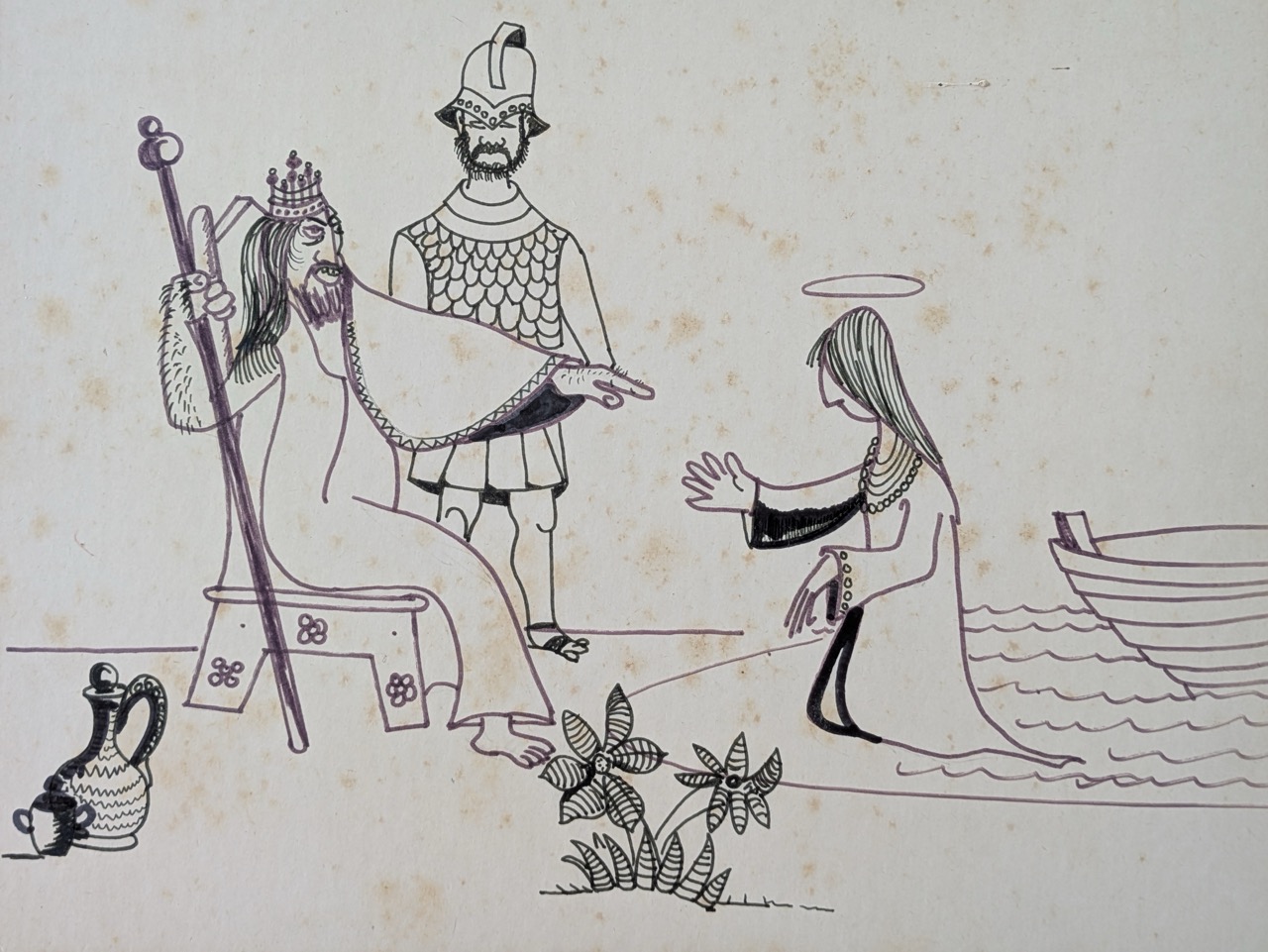
Alongside the Daisy Bates pictures, Gray also produced a series of cartoon-like drawings depicting scenes from the Bible.
These are deceptively simple. Clear line. Minimal detail. Boats, halos, crowns, crosses. The scenes are immediately legible.
They feel closer to medieval marginal drawings than modern illustration. Flat, symbolic, and direct. There’s no spectacle here. They do their job and move on.
That restraint suits television. These images carry meaning fast. They work in the background. They don’t ask for attention.
What’s striking is how easily Gray moved between modes within the same project. Documentary paintings for Daisy Bates. Symbolic religious cartoons for biblical scenes. Each treated with a different visual logic.
After the broadcast
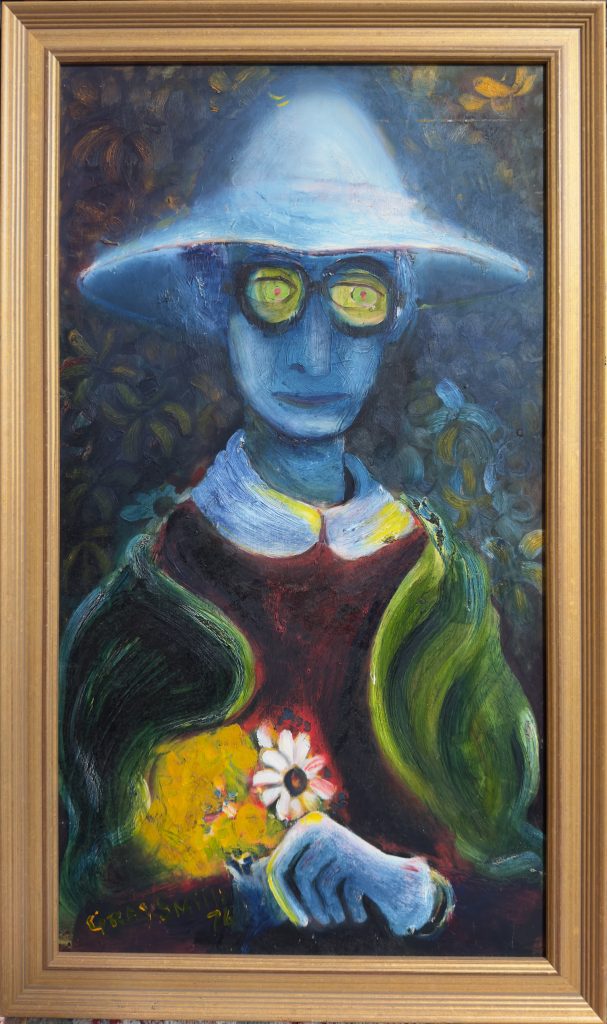
After the series went to air, Gray returned to Daisy Bates in paint.
I’ve seen one painting dated 1976, shown above.
This is not a television painting. There’s no black paper, no concern for broadcast contrast. It’s a studio work, made after Gray had already interpreted Daisy for a national audience.
The familiar markers are there. The wide-brimmed hat. The glasses. The still, guarded posture. But this isn’t documentary likeness. The face feels cool, almost mask-like. The eyes glow rather than observe. The colours feel unsettled.
There’s little sentimentality here. Gray doesn’t soften Daisy or explain her. He leaves the contradictions intact.
Seen alongside the ABC commission, this painting feels like a second pass. Television demanded clarity. Painting allowed ambiguity.
Why it matters
This four-part series confirms that Gray’s work had institutional visibility in the early 1970s. The ABC didn’t stumble across him. They chose him, and they used his work repeatedly across a national broadcast.
Taken together, the documentary images, the biblical cartoons, and the later painting suggest this wasn’t just a job completed and forgotten. Daisy stayed with Gray. Long enough for him to come back and rethink her on his own terms.
Once I’ve watched the full series, I’ll write more about how the images, narration, and music work together. But even now, it’s clear this project sits quietly but firmly inside Gray’s wider practice.
References
Anderson, Don. “Daisy Bates, Superstar.” Bulletin (Sydney, N.S.W), 29 April 1972, 41. http://nla.gov.au/nla.obj-1503220501.
Blom, Diana. Interview by Shawn Callahan. Audio-recorded telephone interview, 26 November 2025. Full transcript available. Unpublished interview. Author’s private archive.