Follow:

The Canberry Paintings: What We Know So Far

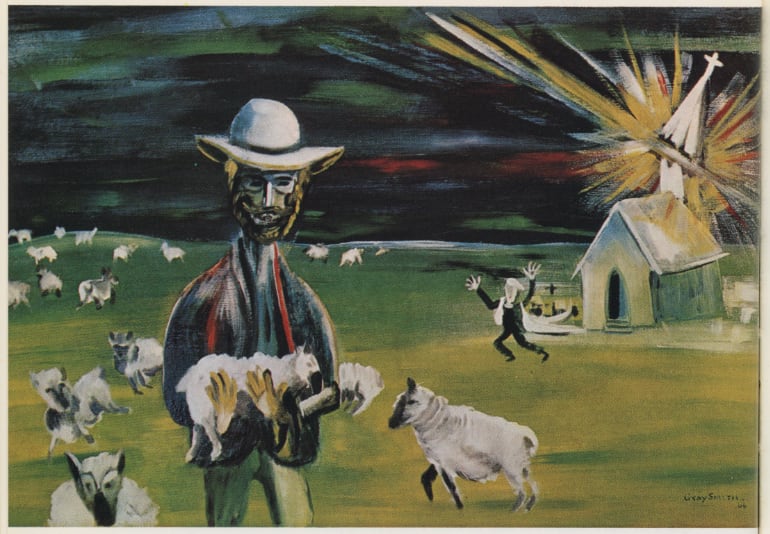
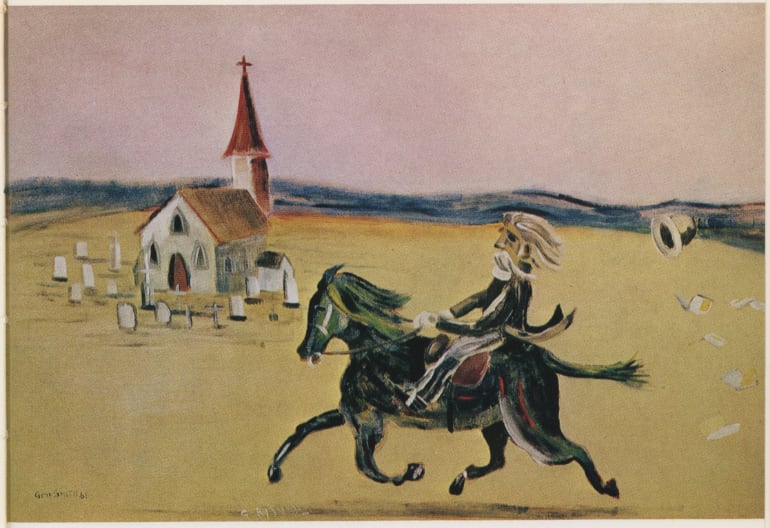
1966 – The Galloping Parson – Gray Smith
Gray Smith, The Galloping Parson, 1966. Enamel on composition board. Private collection. Courtesy of the Smith Estate.
© Smith Estate. Used with permission via CAL.

I want to start working through Gray’s exhibitions one by one, and Canberry Paintings feels like the right place to begin.

Partly that’s personal. I grew up in Canberra and, like Gray and Joan when they began work on this series, I knew very little about the city’s pioneering history. Canberra can feel young, especially in the 1960s. These paintings push hard against that idea.

They’re also beautiful examples of narrative painting. I’ll say more about that in another post, because it one of my career interests.

But most importantly, this post is about getting down what I’ve discovered so far about the exhibition itself. As always, I’m keen to hear about anything I’ve missed or got wrong.

Where and when

The Canberry Paintings exhibition was held at the Theatre Centre Gallery between 8 and 13 November 1966.

The gallery sat inside the building we now know as the Playhouse, part of the Canberra Theatre Centre. The theatre centre had opened only the year before, on 24 June 1965.1 At the time, the ACT had a population of just under 100,000 people, making Canberra a relatively small place.2 In a city that size, places like the theatre centre had to do more than one job. It wasn’t just a theatre. It was a community hub.

Back then, the Playhouse which connected to the main theatre via a covered walkway, housed a 614-seat theatre, a gallery, meeting rooms, and a restaurant.3 The exhibition had real visibility.

The show was sponsored by the Arts Council of Australia, Canberra division, which gave it significant institutional weight.

Opening the show

The exhibition was opened by Mrs Margaret Carnegie, a well-known art collector4 and a strong supporter of Gray’s work.5

Toss Gascoigne, who helped organise an earlier group exhibition that included Gray’s work at the ANU Chifley Library in 1965, later told me a story that still makes me smile. That exhibition included works by Nolan, Boyd, Perceval and others. Toss said he drove out to Margaret Carnegie’s place near Albury to collect the artworks. He was amazed she was happy to hand them over to a first-year student.6 That detail says a lot about her trust, and about how informally art was handled at the time.

Why Canberry Paintings?

Gray and Joan told the press that the immediate trigger for the series was the destruction of Captain Faunce’s cottage in Queanbeyan, the home of the region’s first police magistrate. They were angry that so much of Canberra’s early history was being lost.7

That explanation is true, but it’s not the whole story.

From Joan’s papers, it’s clear she was already working on Canberra’s history before November 1965, when The Canberra Times announced the impending destruction of Faunce’s 1838 cottage.8 The research was underway. The concern about loss had been building for some time.

Coming off the Outback exhibition

Canberry Paintings followed directly from the success of Gray’s Outback series in 1965, his first significant solo exhibition in Canberra. Outback sold well and was well received, and it was a real confidence booster for Gray.9

How the exhibition was received

Contemporary reviews treated the Canberry paintings as narrative works grounded in serious historical research rather than nostalgic illustration.

Writing in The Australian, Noel Pratt emphasised Gray’s year-long immersion in diaries, letters, newspapers and local histories. He described the paintings as a way of restoring Canberra’s first hundred years to view, and challenged the idea of the city as a place without a past.10

Local critics focused closely on how history was handled on canvas, and on the significant role Joan played in researching the series.11 The Canberra Times described the 34 large enamel panels as sympathetic and lightly handled, noting Gray’s use of high colour and his attention to everyday labour, mishaps and moral ambiguity rather than heroic myth.

Individual works were singled out for their interpretive choices, particularly Gray’s portrayal of Ben Hall as a young, clean-faced man rather than a stock bushranger figure. Reviewers also noted his repeated return to domestic and agricultural labour as historically significant acts.

The fact that ANU Press would later use eight of the paintings in Samuel Shumack’s 1967 publication (see below) was seen as further confirmation of the series’ documentary and cultural value.12

Sales and afterlife

The Canberry series didn’t sell as strongly as Outback.

Joan recorded what happened to each painting on a set of handwritten index cards, which we still have. Of the 35 paintings, 18 sold, 16 did not, and one was swapped for another painting. Just over half the works sold.

Several of the unsold paintings later travelled to Paris and the UK for two exhibitions with Arthur Wicks.13 In the list below, I’ve noted which works are now in public collections.

The missing catalogue

One thing I haven’t yet seen is the exhibition catalogue for Canberry Paintings. I’m planning to spend time in the Heide archive and hope to find a copy there. If you have one, or know where one is, I’d love to hear from you.

The research behind the paintings

Joan and Gray did an extraordinary amount of research to uncover the stories behind these paintings. I’m still tracking down all the references Joan would have used, and I have a detailed bibliography that I’ve yet to properly dig into.

Three sources stand out. The last one almost certainly inspired the exhibition’s title.

  • Shumack, Samuel. 1967. An Autobiography or Tales and Legends of Canberra Pioneers. Edited by Samuel Shumack and J. E. Shumack. Canberra: Australian National University Press.
  • Gale, John. 1927. Canberra: History of and Legends Relating to the Federal Capital Territory of the Commonwealth of Australia. Queanbeyan: A. M. Fallick & Sons.
  • Robinson, Fredk. W. 1927. Canberra’s First Hundred Years and After. Second ed. Sydney: W. C. Penfold & Co.

The Shumack paintings

Eight of Gray’s Canberry Paintings were included in ANU Press’s 1967 publication An Autobiography or Tales and Legends of Canberra Pioneers by Samuel Shumack. Some were renamed in Shumack’s book. I’ve listed the original exhibition titles in brackets where they differ.

  • Alan Cunningham (Alan Cunningham – Botanist). Allan Cunningham’s name is misspelt as “Alan” in Shumack’s publication and on Gray’s painting.
  • Stockyards at Acton (Stockyards at Actin)
  • The Galloping Parson, the Rev. Thomas Hassall (The Galloping Parson)
  • The Shepherds’ Rations (10, 10, 2 & ¼ – No Fat)
  • William Farrer’s Experiments (William Farrer)
  • St John’s Struck by Lightning
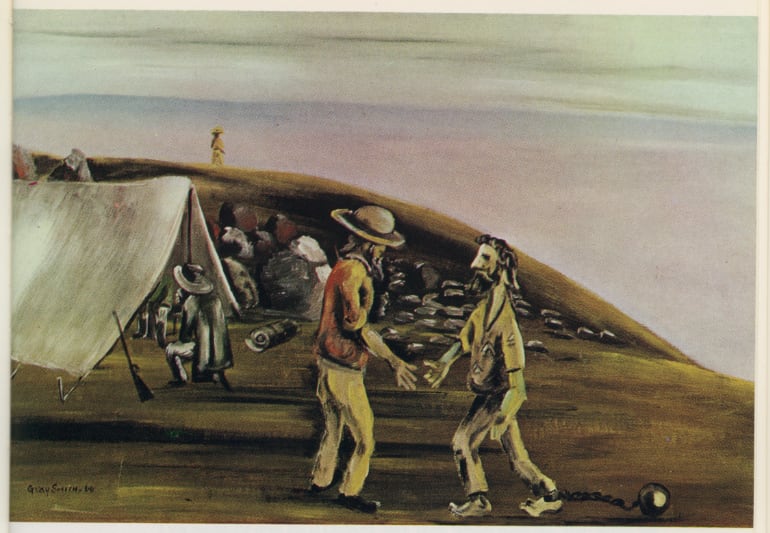
  • The New Recruit
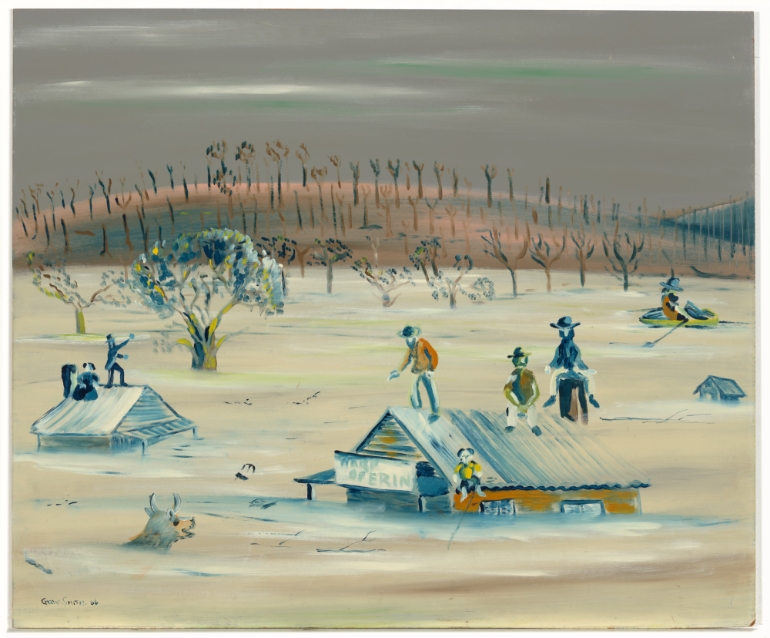
  • The Flooding of ‘The Harp of Erin’ (Harp of Erin Inn Flood)

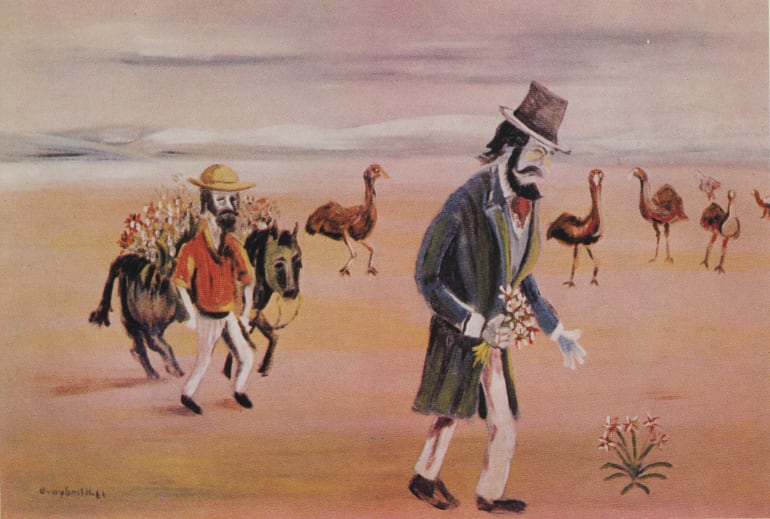
Alan Cunningham

Allan Cunningham was the government botanist and explorer who arrived on the Limestone Plains in 1824.

One journal entry describes “fearless” emus mating in an area that roughly aligns with today’s Northbourne Avenue in central Canberra.
Painting by Gray Smith of botanist Alan Cunningham walking across a dry plain holding flowers, with emus in the background and a second man leading a packhorse.
Gray Smith, Alan Cunningham, Botanist, 1966. Enamel on board. Private collection. Courtesy of the Smith Estate.
© Smith Estate. Used with permission via CAL.

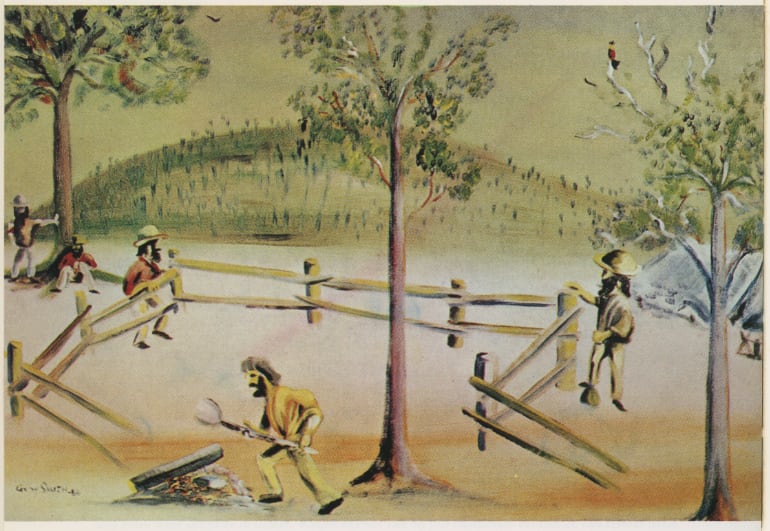
Stockyards at Acton

“When Currie and Ovens touched Limestone Plains in the end of May, 1823, they specially mention that the last white settlement was four days’ journey behind them.
The honour of first establishing settlement on these Plains belongs to two names, Lieut. Joshua John Moore and the Honourable Robert Campbell.”14

1966 – Stockyards at Actin – Gray Smith
Gray Smith, Stockyards at Actin, 1966. Enamel on composition board. 61 x 91.5 cm. Private collection. Courtesy of the Smith Estate.
© Smith Estate. Used with permission via CAL.

The Galloping Parson, the Rev. Thomas Hassall

“For 41 years the saddle was his easy chair.”15

Hassall’s parish stretched from Campbelltown to Goulburn and beyond. Gray treats this not as legend, but as lived effort.

1966 – The Galloping Parson – Gray Smith
Gray Smith, The Galloping Parson, 1966. Enamel on composition board. Private collection. Courtesy of the Smith Estate.
© Smith Estate. Used with permission via CAL.

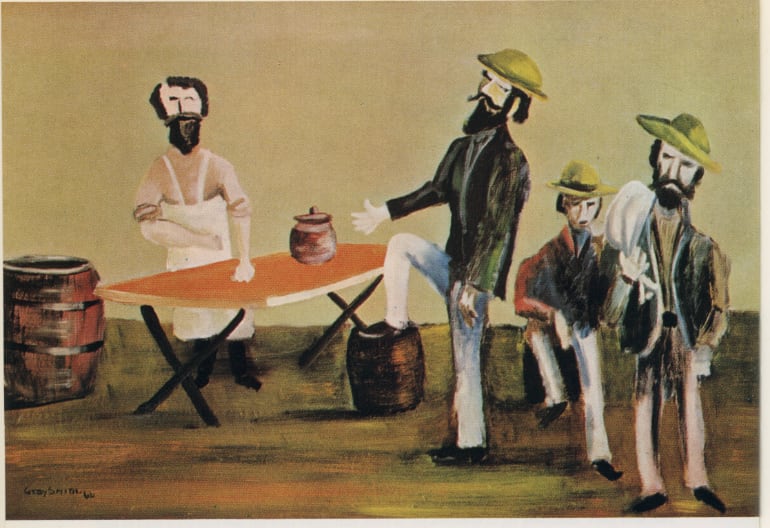
The Shepherds’ Rations

“Shepherds lining up for rations: 10 lb. flour, 10 lb. meat, 2 lb. sugar, ¼ lb. tea.”16

Gray turns a list of measurements into a human moment.

1966 – 10, 10, 2 & ¼ – No Fat – Gray Smith – Web 72dpi 770px
Gray Smith, 10, 10, 2 & ¼ – No Fat, 1966. Enamel on composition board. Private collection. Courtesy of the Smith Estate.
© Smith Estate. Used with permission via CAL.

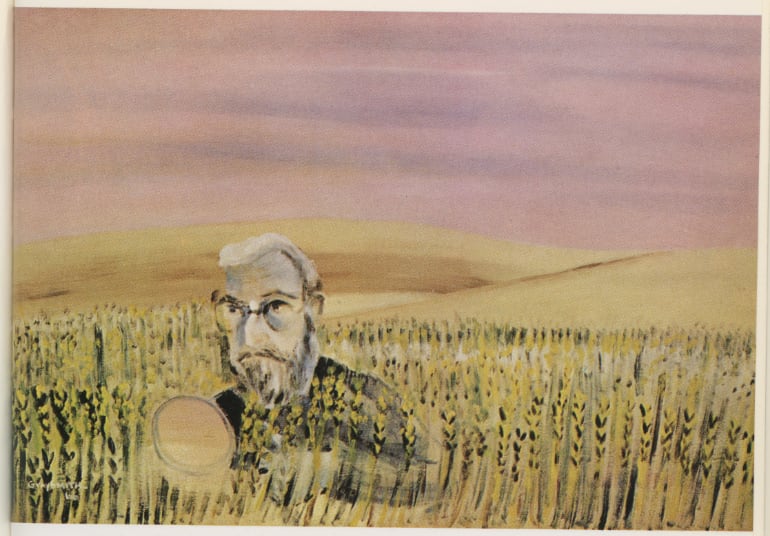
William Farrer’s Experiments

“Farrer, the great experimenter with wheat, on his farm just to the south of the city …”17

1966 – William Farrer’s Experiments – Gray Smith
Gray Smith, William Farrer’s Experiments , 1966. Enamel on composition board. Private collection. Courtesy of the Smith Estate.
© Smith Estate. Used with permission via CAL.

St John’s Struck by Lightning

“According to Mr Mowle’s diary, the original tower was struck by lightning in the night of 6 February 1851 …”18

1966 – St John’s Struck by Lightning – Gray Smith
Gray Smith, St John’s Struck by Lightning, 1966. Enamel on composition board. Private collection. Courtesy of the Smith Estate.
© Smith Estate. Used with permission via CAL.

The New Recruit

“Bushranging was the refuge of the vicious and the victims of the penal system.”19

1966 – New Recruit – Gray Smith
Gray Smith, New Recruit , 1966. Enamel on composition board. Private collection. Courtesy of the Smith Estate.
© Smith Estate. Used with permission via CAL.

The Flooding of ‘The Harp of Erin’

“The great flood of 1870, when the Queanbeyan River burst its banks and flooded ‘The Harp of Erin’.”20

The Harp of Erin Inn Flood
Gray Smith, The Harp of Erin Inn Flood, 1966. Enamel on board, 55 × 110 cm. National Gallery of Australia, Canberra. View work on NGA website. Courtesy of the Smith Estate.
© Smith Estate. Used with permission via CAL.

The Canberry Paintings

  • 10, 10, 2 & ¼ – No Fat
  • A Pioneer’s Recipe
  • Alan Cunningham – Botanist
  • Ben Hall
  • Boiling Down
  • BushFire
  • Cornelius Grady
  • Cuppacumbalong
  • Duntroon House
  • Finding of Gold at Duntroon
  • First Sight of Canberra
  • Garden Party at Glebe House
  • Harp of Erin Inn Flood. Now at the National Gallery of Australia.
  • Laying the Foundation Stone of St John’s Church. Now in the ANU collection.
  • Macpherson at Springbank
  • Right of Way Dispute
  • Robbing the Queanbeyan Coach. Now at the University of Canberra collection.
  • Rung
  • Selecting the Site
  • St John’s Struck by Lightning
  • Sticking Up Moore’s Station
  • Stockyards at Actin
  • The Big Drought
  • The Boundary Rider
  • The Campbells Come to Duntroon
  • The Coming of Ainslie
  • The Drowning of Gregory
  • The Galloping Parson
  • The New Recruit
  • The Robbing of Ainslie’s Camp. Now at the University of Canberra collection.
  • The Shooting of Nelson at Collector
  • The Smash on Stringybark Hill
  • Wheat Farming at Yarralumla
  • William Farrer

A starting point

This post is really the start of my investigation into the Canberry Paintings, not the end of it.

What I’ve written here reflects what I’ve been able to piece together so far from reviews, archives, Joan’s notes and conversations. I’m certain there’s more to learn about how the exhibition came together, how it was experienced, and what it meant to the people who saw it in November 1966.

If you were there, or remember the exhibition being talked about, I’d love to hear from you. And if you have material I haven’t seen yet, a catalogue, photographs, letters, or even a memory you’ve carried with you, I’d be very glad to learn from it.

For me, the Canberry Paintings mark a moment when careful historical research was turned into something lived and visible. They remind us that Canberra had a deep, pioneering past long before it was a capital city. At the same time, the exhibition focuses on settler history and does not engage with the much older and enduring presence of the Ngunnawal people. That silence tells its own story.

There’s much more to uncover. This is just the beginning.

References


  1. Canberra Theatre Centre. 1965. “Canberra Theatre History.” Accessed 17 Jan 2026. https://canberratheatrecentre.com.au/about-us/our-history/canberra-theatre-history/.  ↩︎

  2. Australian Bureau of Statistics. 1966. Census of Population and Housing, 30 June 1966: Australian Capital Territory. Australian Bureau of Statistics (Canberra). https://www.ausstats.abs.gov.au/ausstats/free.nsf/0/462B33A2555159AACA2578EA001BD56E/$File/1966%20Census%20-%20Bulletin%20No%208.1.pdf.  ↩︎

  3. Canberra Theatre Centre. “Our History.” Accessed 17 January 2026. https://canberratheatrecentre.com.au/about-us/our-history/.  ↩︎

  4. Pratt, Noel. 1966. “Canberry on Canvas.” The Australian, 21 September 1966.  ↩︎

  5. Scott, Joan. n.d. Typed memoir of Gray Smith. Private archive.  ↩︎

  6. Gascoigne, Toss. 2025. Interview with Toss Gascoigne. Edited by Shawn Callahan.  ↩︎

  7. “Canberry’s history in paint.” Canberra Times, 3 November 1966, 29. Accessed 8 January 2026. http://nla.gov.au/nla.news-article106944204.  ↩︎

  8. “History is destroyed.” Canberra Times, 1965, 16. Accessed 16 Jan 2026. http://nla.gov.au/nla.news-article105871950.  ↩︎

  9. Scott, Joan. Typed memoir of Gray Smith. Private archive.  ↩︎

  10. Pratt, Noel. 1966. “Canberry on Canvas.” The Australian, 21 September 1966.  ↩︎

  11. “Perfect wife for an artist.” The Canberra Times, 13 October 1966, 20. http://nla.gov.au/nla.news-article106940640.  ↩︎

  12. “Canberry’s history in paint.” Canberra Times, 3 November 1966, 29. Accessed 8 January 2026. http://nla.gov.au/nla.news-article106944204.  ↩︎

  13. Scott, Joan. n.d. Index file recording exhibitions, sales and ownership of paintings by Gray Smith. Private archive.  ↩︎

  14. Robinson, Fredk. W. 1927. Canberra’s First Hundred Years and After. Second ed. Sydney: W. C. Penfold & Co. p. 4.  ↩︎

  15. Ibid., p. 11.  ↩︎

  16. Shumack, Samuel. 1967. Plate facing p. 65.  ↩︎

  17. Robinson, Fredk. W. 1927. Canberra’s First Hundred Years and After. Second ed. Sydney: W. C. Penfold & Co. p. 22.  ↩︎

  18. Ibid., p. 38.  ↩︎

  19. Shumack, Samuel. 1967. Plate facing p. 144.  ↩︎

  20. Ibid., Plate facing p. 145.  ↩︎

Related posts

Picture of Shawn Callahan
Shawn Callahan

Hi, I’m Shawn Callahan, Gray Smith’s son-in-law. A few years ago, I wrote his Wikipedia page, which sparked a deeper dive into his life and work. Since then, I’ve been gathering stories, digging into archives, and speaking with Gray’s family—who’ve been incredibly supportive—to tell his full story. I’m also the author of Putting Stories to Work, an award-winning and best-selling book on business storytelling. Please join me in uncovering the full story of Gray Smith’s life.”

All Posts

One Response

Leave a Reply

Your email address will not be published. Required fields are marked *

Gray Smith Artist