I first wrote about Gray Smith’s The Tank last year, in a post about how this biography project got started.
At the time, I only knew a small part of the story. Enough to see why the painting mattered, but not enough to understand what really happened once it reached New York.
You can read that original post here:
How this biography project got started
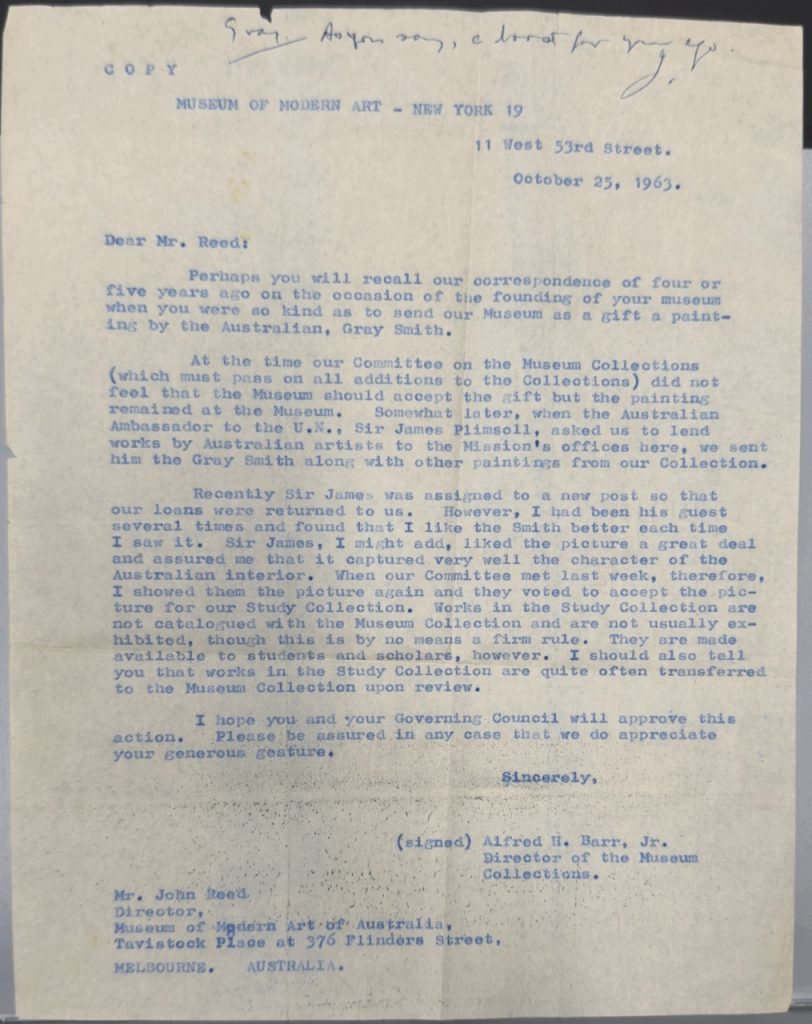
Since then, I’ve spent more time in the Heide archive and uncovered further correspondence. In particular, I’ve found a letter from Alfred H. Barr Jr. dated 25 October 1963. That letter doesn’t overturn the earlier account, but it does change its tone and timing in important ways.
This post is about that fuller picture.
The gift
In 1958, John Reed wanted to mark the opening of his new Museum of Modern Art of Australia with a symbolic gesture to its namesake in New York, the Museum of Modern Art (MoMA).
He could have chosen a Nolan, a Boyd, or a Tucker. Instead, he sent Gray Smith’s The Tank.
Lex Davison, four-time Australian Grand Prix champion and a director of Reed’s museum, carried the painting to New York and delivered it to MoMA in person.
In Modern Love, Lesley Harding and Kendrah Morgan describe what followed:
“He also dispatched council member Lex Davison, who was going to New York on business in 1958, as an envoy to meet with senior MoMA staff and present them with a painting by Gray Smith. The recipients were indifferent to the gift and lent the picture to the Australian Ambassador to the United Nations, before it ended up languishing in MoMA’s study collection.” (p. 271)
Read on its own, that sounds conclusive. The painting arrives, is met with indifference, and disappears into storage.
But the correspondence suggests something more layered.
A wider disagreement
Writing to MoMA’s founding director Alfred H. Barr Jr., John Reed made it clear that The Tank was not an isolated point of contention. Barr had been sceptical about Australian modernism more broadly.
Reed reminded him of their earlier exchanges from the mid-1940s:
“The future of Gray Smith, about whose work we disagreed, remains uncertain as he has been almost continually ill and paints very little. The future of Nolan, etc., about which we also disagreed, seems, however, reasonably well assured, and it is in this connection that I am now writing.” (Reed, p. 577)
So when The Tank arrived at MoMA, it entered an institution that was already hesitant about Australian work as a whole. That context matters.
What actually happened at MoMA
The newly found letter from Barr, written on 25 October 1963, fills in the missing steps.
Barr begins by explaining what happened when the painting first arrived:
“At the time [of receiving The Tank] our Committee on the Museum Collections (which must pass on all additions to the Collections) did not feel that the Museum should accept the gift but the painting remained at the Museum.”
That’s already a quieter outcome than outright rejection. The committee said no, but the painting stayed inside the building.
Barr then explains how the painting left MoMA’s walls:
“Somewhat later, when the Australian Ambassador to the U.N., Sir James Plimsoll, asked us to lend works by Australian artists to the Mission’s offices here, we sent him the Gray Smith along with other paintings from our Collection.”
What follows is the part that changes the feel of the story.
Barr writes that after the loans were returned, his own view of the painting had shifted:
“Recently Sir James was assigned to a new post so that our loans were returned to us. However, I had been his guest several times and found that I liked the Smith better each time I saw it.”
He adds that the ambassador himself was a strong supporter of the work:
“Sir James, I might add, liked the picture a great deal and assured me that it captured very well the character of the Australian interior.”
Barr then describes what happened when the painting came back before the collections committee:
“When our Committee met last week, therefore, I showed them the picture again and they voted to accept the picture for our Study Collection.”
And he is careful to explain what that decision meant:
“Works in the Study Collection are not catalogued with the Museum Collection and are not usually exhibited, though this is by no means a firm rule. They are made available to students and scholars, however. I should also tell you that works in the Study Collection are quite often transferred to the Museum Collection upon review.”
Reading the episode differently
Taken together, these letters tell a more complicated story than the shorthand version.
The Tank was not embraced on arrival. But it was not dismissed and forgotten either. It remained at MoMA, was seen repeatedly by Barr, was strongly liked by Australia’s ambassador, Sir James Plimsoll, and was re-presented to the collections committee with Barr’s support.
That matters.
It suggests that the painting’s eventual place in MoMA’s Study Collection was not a dead end, but a considered and reversible decision. More than that, it shows Barr not as a fixed gatekeeper, but as someone whose view evolved over time through repeated exposure.
The letters don’t turn MoMA into an early champion of Australian modernism. But they do show that The Tank had an advocate inside the institution.
And that advocate was Alfred Barr himself.
References
Barr, Alfred H., Jr. 1963. Letter to John Reed. Heide Museum of Modern Art Archive.
Harding, Lesley, and Kendrah Morgan. 2015. Modern Love: The Lives of John & Sunday Reed. Melbourne: The Miegunyah Press.
Reed, John. 2001. Letters of John Reed: defining Australian cultural life 1920-1981. edited by Nancy Underhill and Barrett Reid. Ringwood, Vic.: Viking.
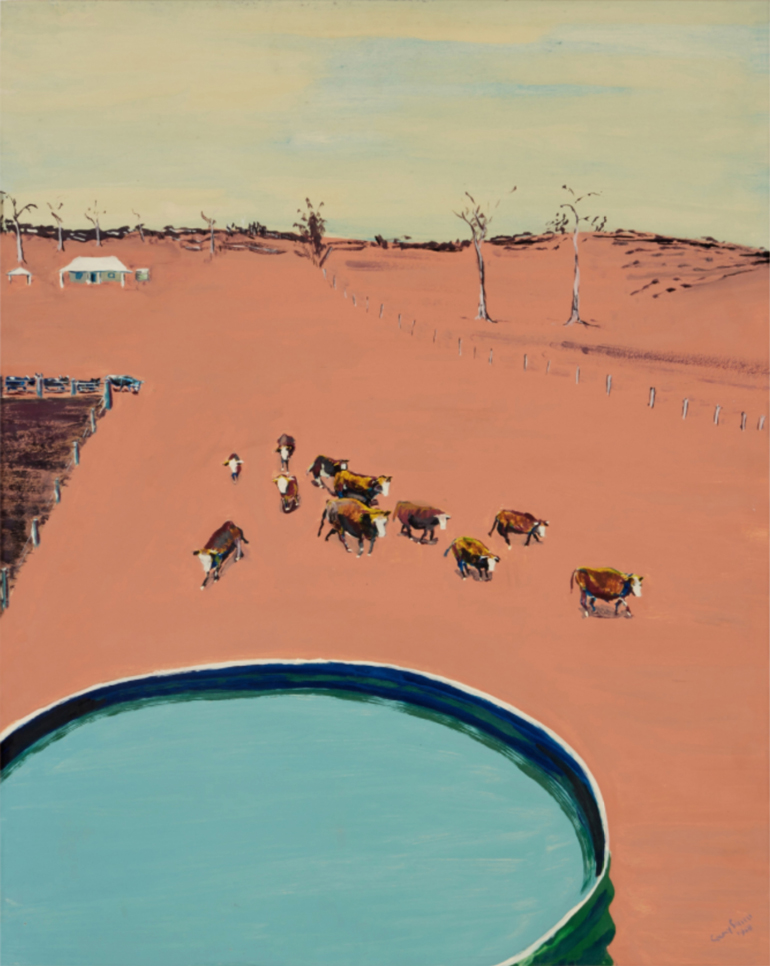
© Smith Estate. Used with permission via CAL.

One Response
It’s worth noting the hand-written note at the top of the letter from John Reed to Gray which say: “Gray. As you say, a boost for your ego. J”