
Falling Flowers was a painting listed in Joan’s index box, but one I had never seen.
For years, it had disappeared.
Now, it’s back.
Gray painted it in Paris in 1967. It’s signed and dated. The scene shows a street parade, flowers falling through the crowd. When you see it, there’s no doubt it’s his.
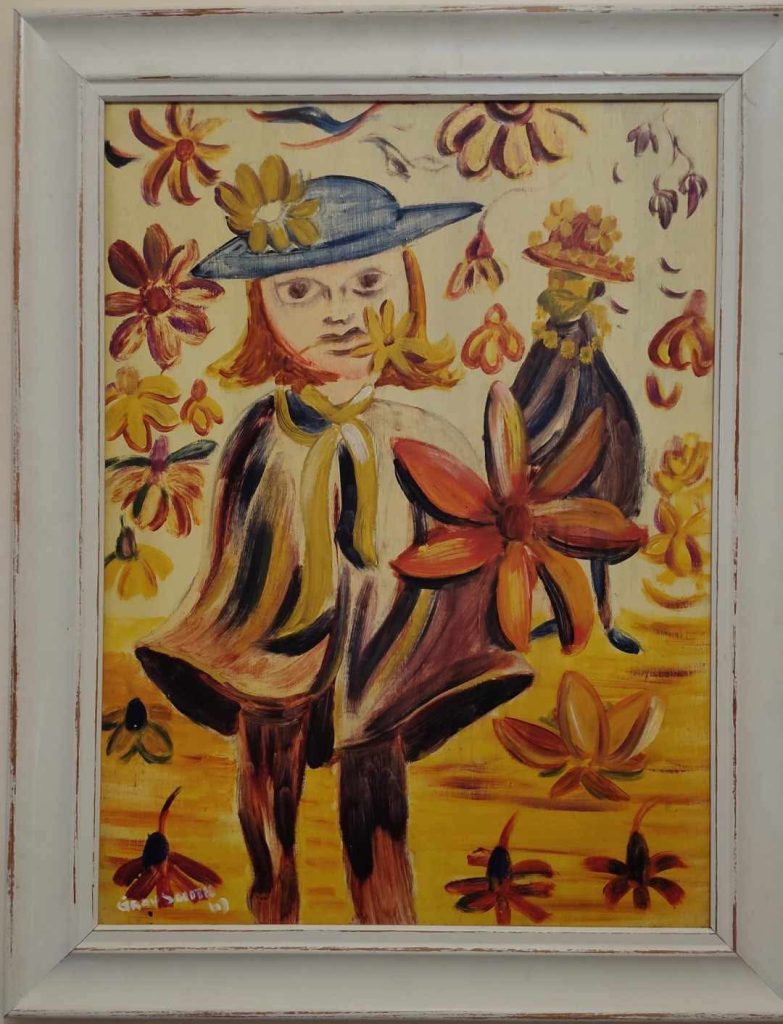
© Smith Estate. Used with permission via CAL.
We know from the index card that it was exhibited at the Australian Sculpture Gallery in 1968, soon after he returned to Australia.
And then, it vanished. I have a theory about what might have happened.
Decades later, in Wodonga, Victoria, a woman walked into a local recycle shop.
She was there to buy furniture.
She had just left a difficult relationship and had almost nothing to her name. It was a tough time.
She saw the painting.
It was love at first sight.
She didn’t know who Gray Smith was. But something about it stopped her. She chose it and took it home.
Later, she wanted to find out more.
In 2013, she showed the painting to Fern Smith, Gray’s daughter.
Fern recognised it straight away. She remembered her father painting it in Paris.
The painting measures 61 cm x 45.5 cm.
It has stayed with her ever since.
She told me, “She’s been a powerful symbol of triumph over adversity ever since.”
“I like to think that she found me.”
So how did a painting made in Paris in 1967 end up in a recycle shop in regional Victoria?
There might be a clue.
Gray had a supporter named Margaret Carnegie. She was a famous collector who opened his Canberry exhibition in 1966. It’s very likely she bought his work.
At the time, Margaret was living on a cattle farm in the Kiewa Valley, not far from Wodonga.
It raises a possibility.
That Falling Flowers was once in her collection. That it stayed in the region. And that, over time, it found its way into a Wodonga recycle shop.
At this stage, that’s just a theory.
If you can help confirm or rule it out, I’d love to hear from you.
I’m looking for any record of Margaret Carnegie’s collection, or any memory of the works she owned.
Because while Falling Flowers has reappeared, part of its story is still missing.

5 Responses
Great find!
Love it…the story (so far) and the painting!
If you are looking for information about Margaret Carnegie contact Wagga Wagga Art Gallery, Charles Sturt University in Wagga, and the Riverina Archives. The gallery has some of her collection and the university has a collection of her books.
Thanks Sue. I sent an email to Wagga Wagga Art Gallery a couple of weeks ago, but have heard nothing back. I have another line of investigation. Someone I know knows a Carnegie family member. I’ll be sure to post what I discover.
Perry, Gray’s son, sent me an email today and said, “Falling Flowers was painted not long after we all had been to a Matisse exhibition, and he was trying to be more flamboyant like the master.”