
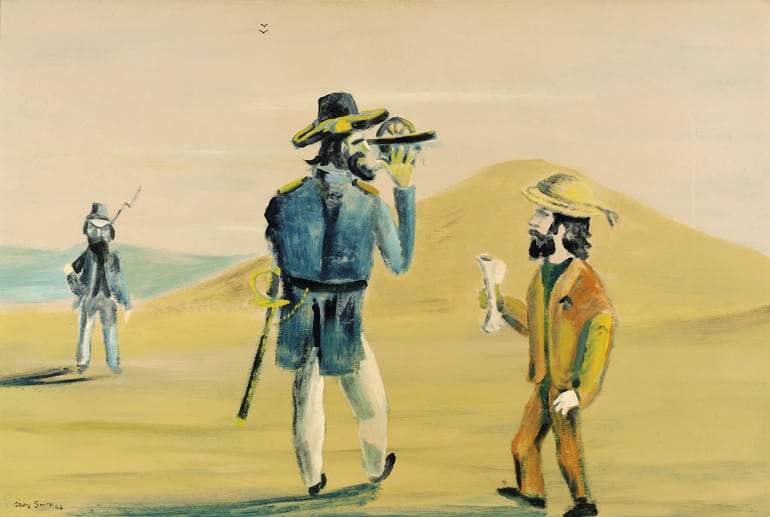
Gray Smith’s First Sight of Canberra recently sold at auction. Painted in 1966, it was the first work listed in his exhibition The Canberry Paintings: The First Hundred Years.
I think it deserves a closer look. It brings together two things that make Gray’s Canberra work particularly interesting: his way of telling stories through painting, and his involvement in a city trying to understand its own history.
© Smith Estate. Used with permission via CAL.
Three men stand in an open landscape. The central figure holds what appears to be a sextant to his eye. Another holds what a roll of paper. Farther back, a third man stands with a long gun. Beyond them, yellow hills give way to blue-green country.
There is very little detail to tell us exactly where we are. Gray gives us the figures, their gestures and the sweep of the landscape. The raised instrument supplies the action, suggesting a pause to take a sighting.
The story behind the scene
The original exhibition catalogue identifies the subject as a journey made in 1820 by Dr Charles Throsby, a former naval surgeon, accompanied by his convict overseer Wild and Constable Vaughn. Searching for the Murrumbidgee River, they crossed country at what later became the northern end of the ACT.
The catalogue helps us understand the scene, but the painting gives the journey a human scale. Three figures and a few gestures are enough to suggest an episode in a much larger story.
This is one of the things I enjoy about Gray’s narrative paintings. He finds a moment that can carry the story without trying to fit every detail onto the board.
Painting Canberra’s past in 1966
First Sight of Canberra was shown at the Theatre Centre Gallery in November 1966, in an exhibition sponsored by the ACT Division of the Arts Council of Australia and opened by Margaret Carnegie.
Canberra was changing quickly. Gray and Joan were concerned about the disappearance of old buildings and the loss of knowledge about the district’s past. Joan spent about a year researching the series, working through historical material and visiting places around the region.
A contemporary Canberra Times article described the paintings as beginning with Throsby’s journey in 1820 and ending with the selection of the national capital site in 1908. First Sight of Canberra therefore had a particular job within the exhibition. It introduced the country before the city that visitors knew.
For someone standing in a new gallery in a rapidly growing national capital, that would have been an interesting encounter. The familiar name “Canberra” was attached to a landscape without its familiar buildings.
Gray’s way of seeing
Painted in enamel on masonite, the work uses broad areas of colour and loosely described figures. The dark blue clothing of the central man stands against the pale country. The warmer colours of the figure beside him connect him to the yellow hills.
Gray’s experience within the Heide Circle matters here. He brought a modernist painter’s interest in colour, shape and expressive figures to the telling of local history. The landscape is simplified, and the men are distinctive without being carefully finished portraits.
For me, that gives the painting much of its life. The arrangement of the figures and the colour carry our attention across the scene, while the historical subject gives us a reason to spend time with it.
It is also a reminder of what Gray contributed to Canberra. He arrived with an established artistic life behind him and found subjects here that sustained a substantial body of work. The Canberry paintings show how closely he and Joan became involved in the history of the place where they lived.
Looking at the title today
“First sight” belongs to the European account represented in the painting. This is Ngunnawal Country, already known and inhabited for thousands of years before Throsby’s party arrived.
That limitation is part of understanding the work. We can appreciate Gray’s painting and Joan’s research while recognising that the series tells a settler history of Canberra.
Sixty years after it was painted, First Sight of Canberra remains an important example of Gray’s engagement with his adopted city. It brings his experience as a modernist painter to a local historical subject, and records the work he and Joan undertook to make Canberra’s past better known.