Follow:

Gray Smith’s First Job


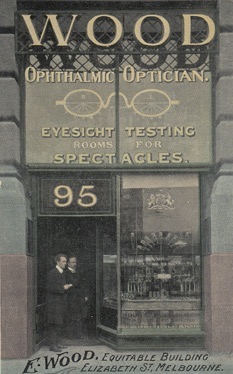
Gray left school at 15 and his first job was working as an optical machinist at E. Wood and Son at 95 Elizabeth Street, Melbourne. He would have spent long days in a small, dusty workshop, cutting and shaping glass for spectacles. The work was exacting. Round blanks of crown glass were ground on a motorised lathe, their surfaces smoothed with abrasive until they matched the prescription. The machine had a spinning wheel and a water drip to keep the glass cool, and if your hand slipped or you lost focus, the lens could shatter, or worse, the wheel could mangle your fingers.1

Shopfront of E. Wood & Sons, Ophthalmic Optician at 95 Elizabeth Street, Melbourne, shown on a historical postcard.
Australian College of Optometry Museum. Postcard for E. Wood, Ophthalmic Optician, Melbourne. Catalogue no. 3056. Accessed 29 November 2025. https://museum.aco.org.au/archive/3056-postcard-for-e-wood-ophthalmic-optician-melbourne.
The craft itself was more like a jeweller’s than a factory hand’s—polishing, measuring, fitting—and though the pay was modest, the skill was valued by optometrists who relied on tradesmen like Gray to produce precise lenses. As we will see, Gray would put this skill to good use later in life as a jewellery maker. But even in this job he wasn’t making much money. He had to give most of his wages to his Mother and “it went into the house”. She called him “her little man”.2

He did so well at this trade he decided to become an optometrist and enrolled for night classes at The Victorian Optical Association. For £10–15 per year, he could attend classes while being apprenticed at E. Wood & Sons. A typical wage for a tradesman would have been about £4–5 per week. However with his commitments to his Mother, this was not enough. “I didn’t earn enough money at my trade so I became a preliminary boxer.”3

References

  1. W. W. Slade, The Making of a Mechanical Optician: A Practical Treatise on the Mechanical Work of Optometrists and Opticians (Philadelphia: The Keystone Publishing Company, 1909), 7–9, https://archive.org/details/makingofmechanic00slad_0/page.
  2. Gray Smith, “Untitled memoir draft,” Hester and Smith Collection, Heide Museum of Modern Art Archives, Bulleen, Victoria, 14.
  3. Ibid., 1–2.

Related posts

Picture of Shawn Callahan
Shawn Callahan

Hi, I’m Shawn Callahan, Gray Smith’s son-in-law. A few years ago, I wrote his Wikipedia page, which sparked a deeper dive into his life and work. Since then, I’ve been gathering stories, digging into archives, and speaking with Gray’s family—who’ve been incredibly supportive—to tell his full story. I’m also the author of Putting Stories to Work, an award-winning and best-selling book on business storytelling. Please join me in uncovering the full story of Gray Smith’s life.”

All Posts
One Response

  1. I’m amazed at what you can find online. I first learned about Gray starting at E. Wood and Sons in the Heide archives, and thought I’d try a quick search to see if anything about the business still existed. That’s how I stumbled on the Australian College of Optometry Museum and this postcard showing the shopfront at 95 Elizabeth Street. A small but lovely find from Gray’s first job.

    I’m not sure when the photo was taken, but it looks like something from the early twentieth century. What’s your best guess? I’d love to know.

Leave a Reply

Your email address will not be published. Required fields are marked *

Gray Smith Artist