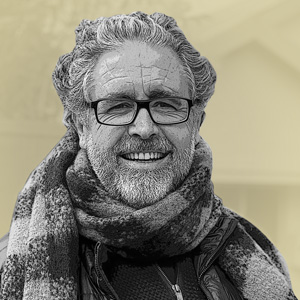
Back in May I wrote about the exhibition Gray held at Henri Souillac’s home in Canberra in 1967, a joint show with John Perceval, and a preview of the paintings about to be shipped to the Cité Internationale des Arts in Paris.
At the time I had the story, but no faces. Now I have both.
I’ve recently obtained a set of press photographs from the National Archives of Australia, taken at that preview. They were shot by the Australian News and Information Bureau, presumably for newspaper distribution, and they have sat in the National Archives ever since, catalogued under a single generic title. As far as I know they have never been published.
Not many people know the exhibition happened at all. When I mentioned it to Kendrah Morgan, the Heide curator behind the recent Perceval retrospective, she was delighted, and asked what paintings of his had actually been in the show. These photographs go some way to answering that, alongside an interview I did with Gray’s son Perry, who was there.
Four different moments are captured across the set. One I can name everyone with confidence. One I think I can. Two I can’t, and I’m hoping someone reading this can help.
A joint show with John Perceval
Joan moved to Canberra in 1961 to be nearer her sister. Gray followed. The family were in Lyneham “in late October of 1961, after Hawthorn won the Grand Final over Footscray.”1
In 1965 the Percevals arrived, John up on a one-year ANU Artist’s Fellowship with Mary and the children, and it was “a real boost for both of us to have some old friends and kindred spirits around the place.”2 Old friends, all four of them, going back to Melbourne and Heide.
Gray’s admiration ran deep, and he measured Perceval against the best painter he knew. “John’s the most creative person I’ve ever met.” It was Perceval’s thinking he prized, “his ability to think… painting and drawing.” More dynamic than Arthur Boyd, though Boyd was the better painter of the two. Boyd “laboured his things.” Perceval had “much more oomph.”3
He worked in the open, in a university building near the ANU staff club that looked onto a public garden, where anyone could wander in and watch. Mornings began at six with coffee that was “half Johnny Walker.”4 It was the opposite of Gray’s tendency to paint by himself.
By 1967 it had caught up with John. He was to travel to Paris with Gray and could not go, “drinking very heavily and in the Canberra hospital,”5 replaced at the last moment by Arthur Wicks. Toss Gascoigne remembered it as “a real mental breakdown.”6
John’s paintings hung on Souillac’s walls that afternoon. But I don’t believe he was there to see them. He appears in none of the photographs.
Gray, Zara Holt and Henri Souillac
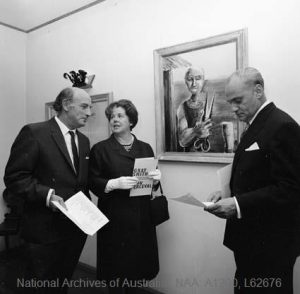
This one I’m sure of. From left to right: Gray, Zara Holt, and Henri Souillac, Cultural Attaché at the French Embassy and host of the exhibition. Zara is holding the programme. A second frame, taken moments later, shows the three of them chatting away.
Zara Holt opened the show. She was also, by this point, taking painting lessons from Gray, which makes her presence here less a courtesy from the Prime Minister’s wife than a student turning up for her teacher.
A portrait, and probably its sitter
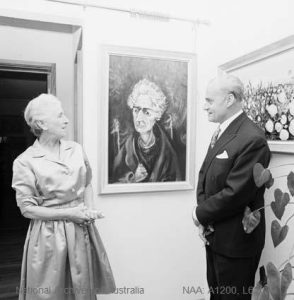
A woman in a satin dress, talking with Souillac. Behind them hangs a portrait Gray had painted the year before: Lady ‘Molly’ Huxley, the regional winner for Canberra and Goulburn in the 1966 Helena Rubinstein Portrait Prize, and a finalist.
I think the woman may be Lady Huxley herself, standing beside her own portrait. If so, she was a considerable figure in Canberra in her own right. She read history at Oxford and became the first lecturer in British History at the ANU. Her husband, Sir Leonard Huxley, was Vice-Chancellor from 1960 to 1967, and she is credited with helping bring the staff together when the ANU amalgamated with Canberra University College.7
I’m not certain it’s her. If you knew Lady Huxley, or can put a name to this face, I’d like to hear from you.
Two more faces
Two more moments from the afternoon, and two faces I can’t put a name to.
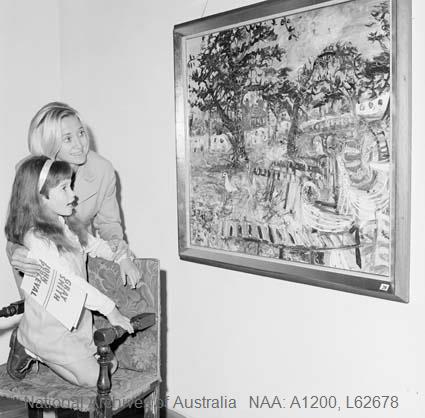
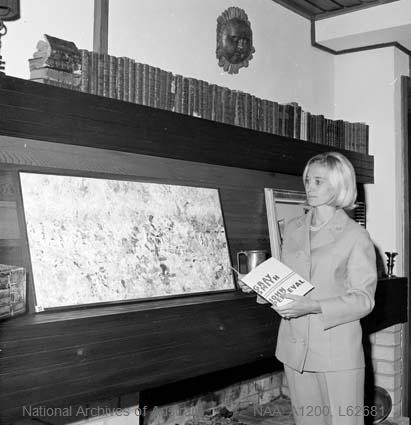
I don’t know who either of these women are. Fern wondered whether the woman at the fireplace might be Tessa Perceval, John’s second child, who would have been about twenty in 1967.8 I can’t confirm it.
If you were at Souillac’s home that day, or you recognise a face, please get in touch.
Why this exhibition matters
Very little is known about this show. It doesn’t appear in most accounts of Gray’s career, or Perceval’s. What we have is Joan’s account, written years later, a couple of interviews, and now these photographs.
The spark was the Canberry series. When that exhibition closed in 1966, Souillac bought two of the paintings, including The Galloping Parson, and afterwards came to Gray with a proposition: a showing at the Cité Internationale des Arts in Paris. The evening at his home the following year was the preview of it, the Paris paintings hung in a Canberra house before they crossed the world, staged “rather exotically” by the architect Enrico Taglietti.9
Within weeks Gray, Joan and the children had sailed for England. Within months he was in Paris. Perceval was not with them.
One more thread I’d like to pull. Henri Souillac’s family stayed on in Australia, and I believe they may still hold at least one Gray Smith painting. If that’s you, or you know them, I would very much like to make contact.
I’d love to know more about the day itself. Who else was there, what hung on which wall, what was said. If any of these faces are familiar, please reach out.
Notes
- Peregrine Smith, interview with Shawn Callahan. ↩
- Joan Scott, undated typed memoir of Gray Smith. ↩
- Peregrine Smith, phone interview with Shawn Callahan, 3 August 2026. ↩
- Ibid. ↩
- Joan Scott, undated typed memoir of Gray Smith. ↩
- Toss Gascoigne, interview with Shawn Callahan, Canberra, 18 October 2025. ↩
- “Inspirational ANU women: Molly Huxley.” ANU Alumni. Accessed 6 August 2026. https://www.anu.edu.au/alumni/our-alumni/spotlight/inspirational-anu-women-molly-huxley ↩
- John Perceval and Mary Boyd had four children: Matthew (b. 1945), Tessa (b. 1947), Celia (b. 1949) and Alice (b. 1957). “Mary Nolan (artist),” Wikipedia; “John Perceval,” Wikipedia. Accessed 7 August 2026. ↩
- Joan Scott, undated typed memoir of Gray Smith. ↩