Follow:

Gray Smith’s 1967 preview exhibition at the French Cultural Attaché’s home

1967 was a productive year for Gray Smith.

He had just had a successful exhibition of his Canberry series in 1966, and there was growing interest in his work. Around the same time, a small private viewing of Gray’s paintings was organised for President Lyndon B. Johnson during his three-day visit to Australia from 20 to 23 October 1966. It was most likely arranged by Zara Holt, wife of Prime Minister Harold Holt, who was taking painting lessons from Gray.

The viewing was arranged on the third floor of the Rex Hotel in Canberra on 22 October 1966. President Johnson does not appear to have attended, but the viewing was still significant. According to Lady Bird Johnson’s diary, it was attended by Lady Bird and their daughter, Anne.1

It may have included some paintings from the Canberry series, but it appears to have been a small selection rather than a full showing of the series.2

At the end of the Canberry exhibition, Henri Souillac, the Cultural Attaché at the French Embassy in Canberra, bought two of Gray’s paintings, including The Galloping Parson.2

According to Joan Scott, Gray’s wife at the time, Souillac then approached Gray with an offer.

Joan later wrote in a brief biography of Gray:

“Henri Souillac who was Cultural Attache to the French Embassy and purchaser of two of the Canberry paintings approached Gray after the show with a proposition that he could have a showing at the International Cite des Arts in Paris.”

Joan went on to describe what happened next:

“Although a preview exhibition was held at Henri’s home (mounted rather exotically by Taglietti) which included work by John (Perceval), he was unable to fulfil the commitment and was replaced at the last moment by Arthur Wicks who was in Paris working in the Power studio. This exhibition was held in 1967 and in June of the same year we all sailed for England.”3

That preview exhibition at Souillac’s home now feels like an important stepping stone in Gray’s career.

It brought together works by Gray Smith and John Perceval. It was opened by Zara Holt, wife of Prime Minister Harold Holt,4 who was also taking painting lessons from Gray. And it was tied directly to the possibility of Gray showing at the Cité Internationale des Arts in Paris.

Nice to have the Prime Minister’s wife open your exhibition. Even better when she’s also one of your students.

Gray was moving in pretty rarefied circles in the 1960s.

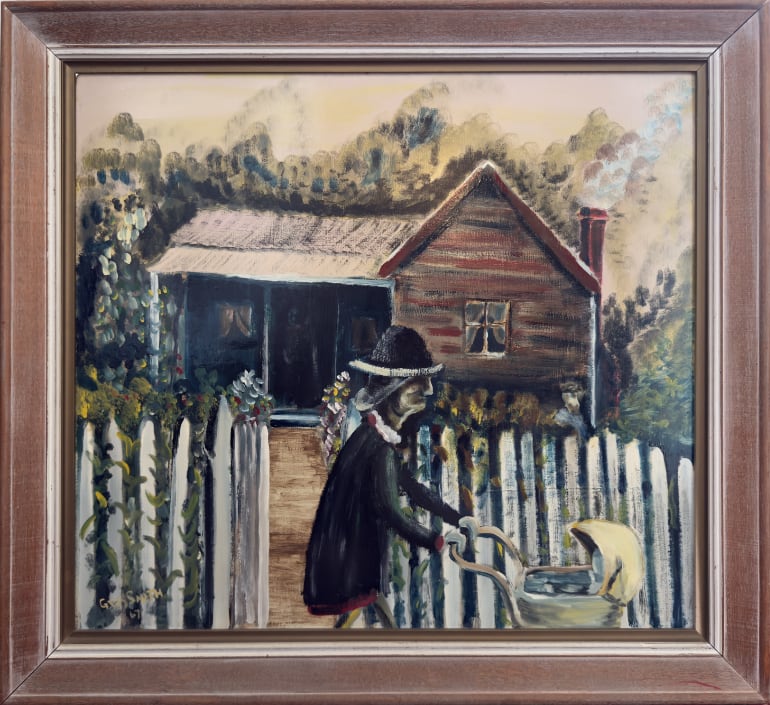
One of the paintings from this moment is Gray’s My Father’s House. On the back of the painting, Gray wrote its French title: La Maison de Mon Père.

Gray Smith’s 1967 painting My Father’s House (La Maison de Mon Père), showing a figure at a white picket fence in front of a timber house with trees behind.
Gray Smith, My Father’s House (La Maison de Mon Père), 1967. Enamel on board. 90 x 91 cm. Private collection. Courtesy of the Smith Estate.
© Smith Estate. Used with permission via CAL.

La Maison de Mon Père appears to have been painted for the preview exhibition held at Souillac’s home in May 1967. Some of Gray’s paintings in the exhibition carried French titles, including Retour à notre enfance (Return to Our Childhood), The Rectory (Le Presbytère) and Le Maître d’École.

According to Joan’s card index, Gray exhibited at least 22 paintings in that preview exhibition:

  • Branding, 1967
  • The Buggy, 1967
  • Bungendore Landscape, 1967
  • Black Cockatoos at Brewarrina, 1965
  • Bush School Teacher, 1967
  • Back to Our Childhood (Retour à notre enfance), 1967
  • The Abandoned Farm, 1967
  • Come-By-Chance, 1967
  • Cotton Field, 1967
  • The Card Players, 1967
  • My Father’s House (La Maison de Mon Père) 1967
  • Mustering, 1967
  • Landscape, 1967
  • My Shearing Days are Over, 1965
  • Major Mitchell Cockatoos, 1966
  • The Rectory (Le Presbytère), 1967
  • The Old Barn, 1967
  • Queanbeyan Visit, 1967
  • Thistles, 1967
  • Scything the Grass, 1966
  • Young Ron, 1965
  • Waiting for the Train, 1965

Many of these paintings were shipped to Paris and exhibited at the Cité Internationale des Arts in 1967. Gray was a little disappointed that the institution didn’t permit him to sell his artworks, so many of the paintings returned to Australia with him and were later sold.5

It’s a fascinating list. Gray was preparing to take his work into a French setting, yet the paintings were still grounded in Australian rural life. The titles move between the local and the European: Bungendore Landscape, Come-By-Chance and Queanbeyan Visit sit alongside La Maison de Mon Père, Retour à notre enfance and Le Presbytère.

That mix feels important. Gray wasn’t trying to become French. He was taking his own world, his memories, landscapes and people, and giving some of them French names for a particular audience and moment.

By June 1967, Gray, Joan and the family had sailed for England. Later that year, Gray would exhibit in Paris with Arthur Wicks at the Cité Internationale des Arts. But before that, there was this smaller, more private preview in Canberra, held in Henri Souillac’s home.

For me, that gives the preview exhibition extra weight. It sits between the Canberry paintings and the European chapter of Gray’s career. It also shows how much interest there was in his work at the time: French Embassy support, a possible Paris exhibition, John Perceval’s involvement, and Zara Holt opening the show.

And there’s another reason to share this list. Many of these paintings haven’t yet resurfaced. If you own one of them, or know where one might be, please get in touch. It would be wonderful for the world to see them again.


Notes

  1. Johnson, Lady Bird. 1966. “Lady Bird Johnson’s Daily Diary entry, October 22, 1966.” LBJ Presidential Library. Accessed May 13, 2026. https://discoverlbj.org/item/ctjd-ctjdd-19661022.
    ↩
  2. Based on Joan’s index card file of Gray Smith paintings.↩
  3. Both quotations are from Joan Scott, typed memoir of Gray Smith, n.d., Canberra.↩
  4. Brook, Donald. 1967. “Australian salon.” Canberra Times, 1967, 31, Leisure–The Arts. Accessed 13 January 2026. http://nla.gov.au/nla.news-article131654146.
    ↩
  5. Smith, Gray. 1967. “Letter to Nobby Elvin.” “Gig Cottage”, 61 High Street, Sutton Courtenay, near Abingdon, Berkshire, UK.
    ↩

Related posts

Picture of Shawn Callahan
Shawn Callahan

Hi, I’m Shawn Callahan, Gray Smith’s son-in-law. A few years ago, I wrote his Wikipedia page, which sparked a deeper dive into his life and work. Since then, I’ve been gathering stories, digging into archives, and speaking with Gray’s family—who’ve been incredibly supportive—to tell his full story. I’m also the author of Putting Stories to Work, an award-winning and best-selling book on business storytelling. Please join me in uncovering the full story of Gray Smith’s life.”

All Posts

One Response

Leave a Reply

Your email address will not be published. Required fields are marked *