One of the great pleasures of this project is that paintings keep appearing.
A couple of weeks ago, a reader subscribed to the Gray Smith Artist Project newsletter and mentioned he had two Gray Smith paintings. He kindly sent through photographs. I was delighted.
Both works add something useful to the record. One helps confirm a painting from Gray’s Canberry Series. The other takes us back to 1958, before Gray moved to Canberra.
© Smith Estate. Used with permission via CAL.
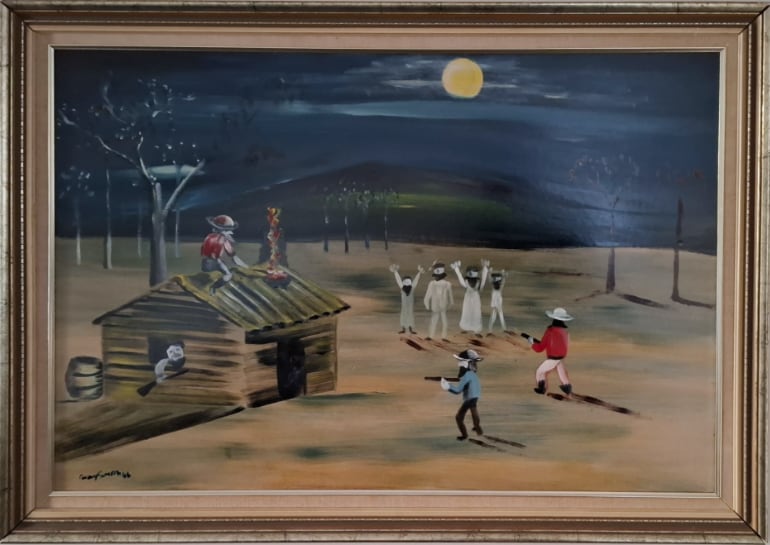
Sticking Up Moore’s Station
The first painting is a moonlit bushranger scene painted in 1966. The owner thought it might be called Bushrangers at Mount Ainslie, but I knew that painting was in the University of Canberra Art Collection.
To check, I called the University’s art curator. They confirmed they had Gray’s The Robbing of Ainslie’s Camp, with that title written on the back of their painting.
The owner’s painting is different. Unfortunately, there is tape across the back, so he can’t see the verso where Gray typically wrote the title of the work. But when I looked through Joan’s card catalogue, one title stood out: Sticking Up Moore’s Station.
Then I checked the description in the original exhibition catalogue. That confirmed it for me.
The catalogue says:
“During 1828, Tennant and Rix stuck up Moore’s station, had all his men ranged up and placed under guard. Mr. Cowan defended his hut, whereupon Tennant tried to burn him out but, fortunately, the bark roof was damp and would not burn. The bushrangers then, after taking some food, made off.”
That’s exactly what the painting shows.
Under a full moon, a group of men stand with their hands up near a timber hut. A bushranger stands on the roof trying to set it alight. Another figure is at the window. Others move across the open ground. It’s theatrical, a little comic, and quietly menacing.
So I’m confident this painting is Gray Smith’s Sticking Up Moore’s Station, 1966.
© Smith Estate. Used with permission via CAL.
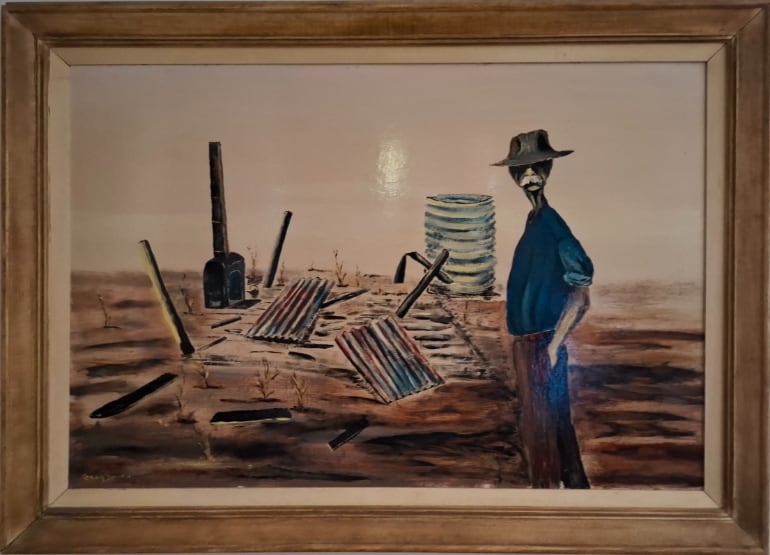
Old Man and Remains of Burnt Out House
The second painting is called Old Man and Remains of Burnt Out House. It is signed and dated 1958.
Like almost all of Gray’s paintings, it is enamel on masonite. The painting shows an old man standing in front of the scattered remains of a burnt-out house. There’s a water tank, sheets of corrugated iron, blackened posts and the dry, open ground that Gray returned to so often in his early work.
The frame also looks original.
Before Gray moved to Canberra in 1961, many of his frames were made by his brother Martin Smith in Melbourne. Gray may even have helped with some of this framing work himself, as he spent time in the family picture-framing business.
Martin was an important framer for the Heide Circle, working with artists including Sidney Nolan, Charles Blackman, Arthur Boyd and John Perceval.
That connection matters because Gray’s paintings often came out of a close world of artists, makers, framers and family. The frame is not the main event, of course, but it can still tell us something about where the work came from and how it was first presented.
Why these discoveries matter
Many of Gray’s paintings have stayed quietly in families for decades. They were bought, inherited, hung in homes, and passed from one generation to the next.
Now, as those collections move again, works are starting to reappear.
That’s why every new contact matters. Each painting helps fill in another part of Gray’s record. A title can be confirmed. A date can be added. A missing work can be matched to Joan’s card catalogue. A painting that was just a memory becomes visible again.
These two works are a lovely example of that.
One gives us another piece of the Canberry Series, Gray’s playful and narrative 1966 group of paintings based on early Canberra history. The other gives us a stark 1958 image of rural loss and survival.
Both are now back in the record.
And that’s a good week for the Gray Smith Artist Project.